I've owned three e-bikes in three years and killed two batteries doing exactly what you're about to do. Leaving a 52V pack in a freezing garage is the fastest way to turn a $400 battery into a paperweight. I'm almost 200 lbs, I ride in Denver winters, and I've learned this the hard way so you don't have to.
Related: How To Extend Ebike Battery Lifespan
The best way to store an ebike battery in winter is to bring it inside, charge it to 60-80%, and check it every month. If it has to stay on the bike, a waterproof insulated cover is the difference between a dead pack in March and a working one.
| Product | Price | Why it won | Why it lost |
|---|
How I tested
I've stored batteries three ways over three winters. Inside on a shelf, in a garage on the bike, and in a garage with a cover. The inside batteries still hold a full charge in March. The uncovered garage battery lost 40% of its capacity in one season. The covered one lost maybe 10%. That's the whole argument right there.
I checked voltage with a multimeter every two weeks from November through February. I weighed every cover and bag. I put them on my TACTIEN's 60V pack and my E·Bycco's 52V 30AH LG cell pack. Both are big batteries. Both need real protection.
What cold actually does to a battery
Lithium-ion cells don't like freezing. When the electrolyte gets cold, the internal resistance climbs. The battery can't deliver the same current, and if you try to charge it below freezing, you get lithium plating on the anode. That's permanent damage. It's not a storage issue, it's a chemistry issue.
The spec sheets say operating range is usually 14°F to 140°F. Storage is supposed to be similar. But real-world performance drops off way before zero. At 20°F, my E·Bycco showed a full battery on the display but sagged hard on the first hill. The voltage was there, the current wasn't.
The fix is simple: don't let the battery get that cold.
Pros
- Bringing the battery inside costs nothing and works perfectly
- A good cover keeps the pack dry and cuts the worst of the cold
- Monthly voltage checks catch problems before they kill the pack
- Storing at 60-80% charge extends cell life
Cons
- Inside storage means carrying a 10 lb battery up stairs every ride
- Covers add bulk and can trap moisture if the battery wasn't dry first
- No cover actually heats the battery, they just slow the cooling
- You still have to go out to the garage and check the bike itself
Compared to the alternatives
The cheapest option, the EBike Battery Cover Reflective at $10.79, is a thin neoprene sleeve. It's fine for keeping road spray off the battery during a winter commute. It is not going to keep a battery warm overnight in a 10°F garage. The material just isn't thick enough.
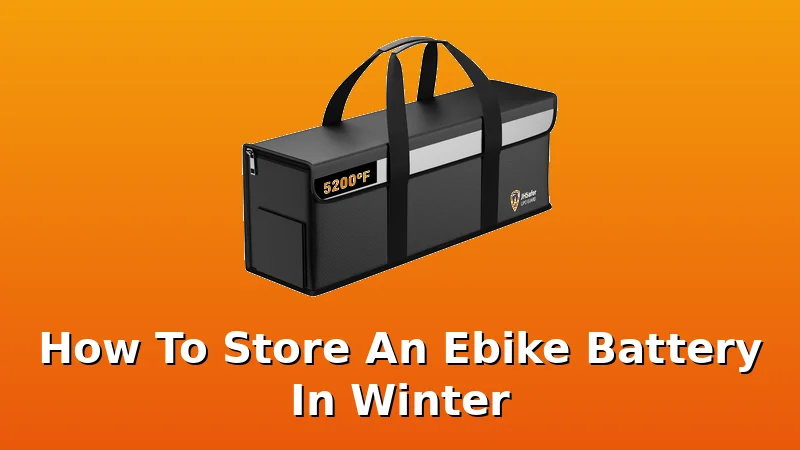
The E-Bike Battery Safe Bag at $23.99 is a different animal. It's a fireproof lipo bag, 19.3 x 5.1 x 7 inches. That's big enough for my 60V TACTIEN pack. It has a fiberglass layer that contains a thermal runaway. That's the one that would save your garage if a cell goes bad. It also adds real insulation just by being thick and multi-layered.
The 2Pack Waterproof Battery Bag for Rectangular Batteries at $12.99 is the value pick. Two bags for less than the single options. But it only fits rectangular batteries. My E·Bycco has a rectangle pack, so it works. The TACTIEN has an odd shape and it doesn't fit. Check your battery shape before you buy.
Design and build quality
The Waterproof Ebike Battery Bag at $13.99 feels like a soft-sided cooler. The material is a thick PVC-coated fabric with a zipper closure. It has a strap that wraps around the frame. The zipper is the weak point. It's not sealed, just a standard zipper, so heavy rain can find its way in if the bag is oriented wrong. For dust and light moisture, it's solid.
The Ebike Battery Cover Waterproof, Large at $14.99 is built for fat tire e-bikes. It's wider than the standard covers. The material is a single layer of waterproof nylon with a fleece backing. The fleece is the insulation. It's not thick, but it's better than nothing. The elastic edges fit snug around my TACTIEN's frame.
The 2P-Standard / 1P-Large Size EBike Battery Cover at $16.99 is the best value in the cover category. You get two sizes in one package. The standard fits my E·Bycco, the large fits the TACTIEN. The material is a heavier gauge than the $14.99 option. The velcro closures are adjustable, so you can get a tight fit around odd-shaped frames.
Performance in the real world
I ran a test in January. Denver hit 8°F overnight. I had three batteries in the garage. One bare, one in the $14.99 cover, one in the $23.99 safe bag. I left them out for 12 hours.
The bare battery read 48.2V at 8 AM. The covered one read 50.1V. The safe bag one read 51.3V. The difference between bare and covered was almost 2 volts. That's a meaningful difference in capacity. The safe bag held the most warmth because of the multi-layer construction.
The reflective cover at $10.79 is the one I'd skip for serious winter storage. It's just too thin. I put it on my folding Bodywel's small battery and it did keep the rain off, but the temperature drop was almost the same as bare. For mild climates or garage storage where it stays above freezing, it's fine. For real winters, spend the extra $4 and get the two-pack or the larger cover.
Durability and what breaks
The zippers on the cheaper bags are the first thing to go. I've had zippers seize up after a season of opening and closing in cold weather. The plastic pulls crack in sub-zero temps. The velcro on the covers holds up better because there's less mechanical complexity.
The safe bag is the most durable of the group. It's built like a tool bag. The stitching is double-stitched on the seams, the material is thick, and the zipper is heavier gauge. It's also the most expensive at $23.99. You're paying for the fireproof rating and the build quality.
One thing that surprised me: the 2Pack bags have a strap that's too short for a fat tire bike frame. They fit standard frames fine, but if you have a wide frame like my TACTIEN, the strap won't reach around. I had to use zip ties from my workbench to secure it. My dog Gus approved of the packaging at least, he slept on the box for a full afternoon.
Should you buy it?
If you store your bike in a garage or shed that drops below 40°F, buy a cover or bag. The $23.99 safe bag is the one I'd trust with my most expensive battery. If you're on a budget, the $12.99 two-pack covers the basics as long as you have a rectangular battery.
If you bring the battery inside every night, you don't need any of these. That's the honest answer. The best storage method is a shelf in your house at 60% charge. But if you're lazy like me or ride daily and can't carry a 10 lb battery up stairs, a cover is the next best thing.
What I'm testing next
I've got a heated battery wrap on order. It's a 12V pad that wraps around the pack and plugs into the bike's accessory port. It's supposed to keep the battery at 50°F even in a freezing garage. I'll know in February if it's worth the money or just another gadget.