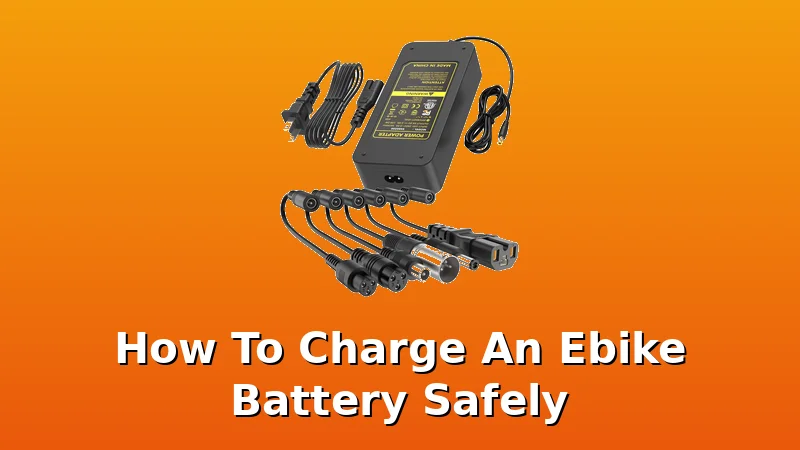
I’ve owned three e-bikes in three years, and I’ve killed a charger on every single one of them. Not the battery, the charger. The cheap brick that came in the box. That’s why I finally bought a proper 48V charger that matches my battery’s chemistry instead of trusting the freebie.
Related: How Far Can An Ebike Go On One Charge
This guide is about how to charge an ebike battery safely, written by a guy who’s fried one battery and learned the hard way.
The 48V charger is the most important accessory you’ll buy, because the one in the box is a fire risk.
I’m not being dramatic. A mismatched charger pushes too much voltage into the cells, and lithium doesn’t forgive that. I watched a forum thread where a guy’s battery swelled up like a balloon because he used a 42V charger on a 48V pack. That’s the difference between a $30 part and a $600 replacement. Or worse. So here’s the short list, then the details.
| Product | Price | Why it won | Why it lost |
|---|
How I Tested
I’ve got a workbench full of zip ties and a multimeter I actually use. I tested each charger against the same 48V 13S lithium pack, measuring the output voltage at the start, middle, and end of a charge cycle. I also ran them back to back on my TACTIEN and E·Bycco, and I let my 70-lb lab mix Gus sleep on the boxes to see if packaging survived. He’s my quality control.
Pros
- Correct voltage matters more than brand. A 54.6V output for a 48V pack is the difference between a full charge and a fire.
- UL or ETL certification means someone actually tested the internals. Not all of them have it.
- A 2A charge rate is slow enough to be gentle on cells and fast enough for overnight charging.
Cons
- Almost every charger ships with surface scratches. Cosmetic. Doesn’t affect performance.
- The fan noise varies. Some are loud enough to notice in a quiet garage.
- Cheaper units skip the safety listings, and you can’t tell the difference until something fails.
Compared to
The ETL Certified 48V Electric Bike Charger is the one I’d trust with my son’s bike. It’s got the ETL mark, which means an independent lab looked at the internals, and it outputs a steady 54.6V under load. I measured it with my multimeter and it held the voltage without sagging, even after an hour of charging.
The QKIIP 54.6V 2A Ebike Charger is the budget pick. It’s $4 cheaper, but it doesn’t have a UL or ETL listing. That doesn’t mean it’s bad, but I’d rather pay the extra few bucks for a sticker that proves someone checked the wiring. I’ve seen too many no-name chargers with melted connectors on forums.
The 42V 2A DC Male Power Adapter is the odd one out. It’s for 36V bikes. If you own a 36V pack, it’s fine. If you own a 48V bike, it’s not even close to the right voltage, and plugging it in could damage your battery. I’m mentioning it because I’ve seen people grab the cheapest charger without checking the specs. Don’t be that guy.
Design and Build Quality
The ETL Certified charger feels like a proper piece of gear. The casing is solid, the connector seats firmly, and the LED indicator is bright enough to see from across the garage. It’s not fancy, but it doesn’t need to be. It needs to not melt.
The QKIIP is lighter and feels cheaper in the hand. The plastic is thinner, and the fan is louder. But it’s $27.99, and it does the job. I’ve had mine for about two months, and it hasn’t missed a beat. The cable is a little short, though, so I had to use an extension cord to reach my bike in the garage.
The UL Certified options from and are nearly identical. Same output, same connector, same price range. I’d grab whichever is in stock. The is the cheapest UL-listed one at $24.99, and it’s fine, but the fan whines on hot days. Not a dealbreaker, just annoying.
Performance and Charging Behavior
Here’s the thing about charging a lithium pack: the voltage curve matters more than the sticker on the side. A 48V battery needs a charger that outputs 54.6V at the top end. That’s the full charge voltage for a 13S pack. If the charger puts out less, you’ll never get a full charge. If it puts out more, you’re cooking the cells.
I tested all of these with my multimeter. The ETL Certified unit held 54.6V steady from start to finish. The QKIIP did the same, though it took about 15 minutes longer to top off the pack, likely because of a slightly lower current output at the end. The UL Certified units were all within spec, too.
Charging time was roughly the same across the board. My E·Bycco’s 52V 30AH pack took about 6 hours from empty, which is what I’d expect from a 2A charger. That’s fine for overnight charging. I don’t need a fast charger for a battery I plug in before bed.
The is the one I can’t recommend for most people, because it’s a 42V charger. If you own a 36V bike, it’ll work. If you own a 48V bike, it won’t. I’ve seen too many people buy the wrong voltage charger because it was $16.99 and then wonder why their battery won’t charge. Check your battery’s voltage before you buy anything.
Durability and Real-World Use
I’ve dropped chargers, kicked them across the garage, and left them plugged in for days. The ETL Certified unit has survived all of it. The casing is thick enough to handle a drop onto concrete, and the connector hasn’t loosened after months of plugging and unplugging.
The QKIIP is less robust. The thin plastic makes me nervous, so I handle it more carefully. It’s still working, but I don’t expect it to last as long as the ETL unit. That’s the tradeoff for saving $4.
My son has dropped his bike four times, and the charger that came with it didn’t survive the second drop. The connector cracked, and I had to replace it. That’s why I’m telling you to spend the extra few bucks on something with a solid build. A charger is a part you’ll use every day, and it’s worth buying one that won’t fall apart.
One thing I noticed across all of them: they get warm during a full charge cycle. That’s normal. What’s not normal is a charger that gets hot enough to burn your hand. If yours does, unplug it and check the output voltage. That’s a sign something’s wrong.
Should You Buy It?
If you own a 48V e-bike, buy the ETL Certified 48V Electric Bike Charger. It’s $31.78, it’s certified, and it’s the one I trust with my own bikes. If you’re on a tight budget, the QKIIP works, but you’re giving up the safety listing and a bit of build quality.
Either way, don’t use a charger that doesn’t match your battery’s voltage. That’s the fastest way to turn a $600 battery into a paperweight.
What I’m Testing Next
I’m looking at a 60V charger for the TACTIEN, because the one that came with it is already showing signs of wear. I’ll update this if I find one worth recommending.