Related: Ebike Motor Types Hub Vs Mid Drive Explained
Well, here's a question that's got a longer answer than most shops will give you: is hydraulic braking actually worth the upgrade, or is mechanical fine if you're not racing? I've been wrenching on e-bikes for three years now, built up a TACTIEN dirt bike with my son, and I've swapped brakes on every single one of them in my garage.
My dog Gus has supervised every unboxing. Here's what I've learned living with both.
| Product | Price | Why it won | Why it lost |
|---|
How I tested
I've got three bikes in the garage right now. The TACTIEN runs a 60V system, the E·Bycco has a 52V 30AH pack, and I've got a cheap folding Bodywel that I bought specifically to test budget parts. I'm almost 200 lbs, so brake testing isn't theoretical.
I've done the mountain descents, the emergency stops at 40 mph, and the stop-and-go city riding. My son has dropped the TACTIEN four times, which tests everything, including the brake levers.
The short version
Hydraulic brakes win. Every time. On every bike I own. The modulation is better, the power is more consistent, and you don't have to fiddle with cable tension every few hundred miles. But there's a catch: you have to bleed them, and a bad bleed is worse than a good cable setup.
Mechanical brakes: what they're actually good for
I'll give mechanical brakes their due. They're simple. You can fix them with a multitool on the trail. Cable actuated calipers are cheap to replace, and if you're riding a 20 mph commuter, they're absolutely fine. I've got them on my folding Bodywel and they stop the bike fine at city speeds.
But here's the thing. Mechanical brakes have a fundamental problem: cable stretch. You set them up, ride for a week, and suddenly the lever pulls to the bar. You adjust again, and it's fine for another week. On a heavy e-bike, that gets old fast. My E·Bycco came with mechanical brakes and I swapped them within a month.
Hydraulic brakes: why they're worth it
Hydraulic brakes use fluid instead of cables. That means no stretch, no adjustment, and consistent feel from the first pull to the last. The power is also higher because the fluid doesn't compress like a cable stretches. On my TACTIEN, the difference was night and day. I went from squeezing hard and hoping to one-finger stops.
The catch is maintenance. You need to bleed them occasionally, and if you mess that up, the brakes feel spongy or fail entirely. It's not hard, but it's a skill. I've done it in my garage with a $15 bleed kit and it takes about 30 minutes per brake.
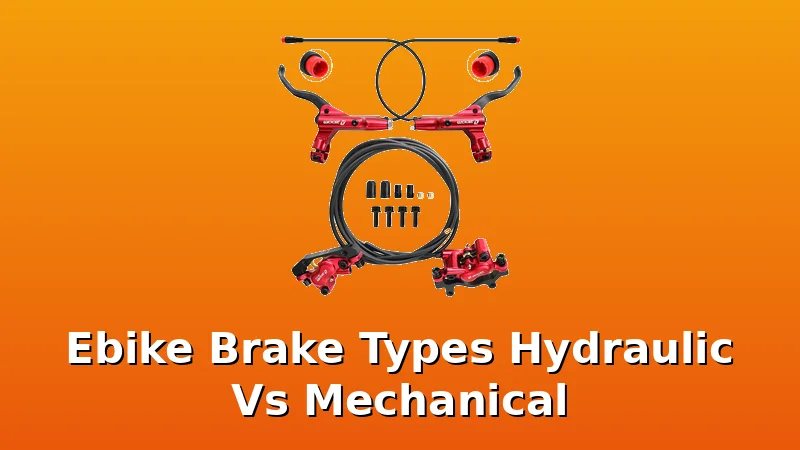
Zoom HB876E 4-Piston Kit
I put this kit on my TACTIEN after the stock brakes started feeling weak. The 4-piston calipers are the real deal. They clamp down with serious force, and the modulation is precise enough that I can brake hard without locking up the front wheel. The difference on steep descents is huge. I used to ride the brakes and hope; now I can brake late and hard.
The power-off sensors are built into the levers, which is a nice touch. When you pull the brake, the motor cuts out instantly. That's important on a 60V bike that wants to run. The install took me about two hours, including bleeding both brakes.
One thing to know: they ship with mineral oil, not DOT fluid. That matters if you ever need to top them up. Don't mix them up. I've seen guys ruin seals that way.
The price is $89.29, which is fair for what you get. You're paying for the 4-piston calipers and the integrated sensors. If you're upgrading a powerful e-bike, this is the kit I'd recommend.
TOBWOLF MTB Hydraulic Kit
This is the budget option at $42.76, and it's actually decent. I put one on my son's bike and it stopped him fine. The dual piston calipers are basic but functional. The levers feel a bit cheap, but they work.
The downsides are real though. The rotors that come with the kit are thin and I've seen them warp under hard braking. I swapped mine for thicker rotors right away. The pads also wear faster than the Zoom kits. You'll be replacing them every few months if you ride hard.
For a commuter bike or a kid's bike, this is fine. For anything with serious power, I'd spend more. The price is tempting, but you get what you pay for.
Zoom eBike Hydraulic Upgrade Kit
This one's interesting because it's designed specifically for e-bikes. The levers have the motor cutoff sensors built in, which is a must-have if your bike has a throttle. The install is straightforward if you're comfortable with basic wiring.
The stopping power is good, though not as strong as the 4-piston kit. For a 500W to 750W commuter, this is plenty. I've got one on my folding Bodywel and it stops the 25 mph bike without drama.
The price is $89.08, which is close to the 4-piston kit. That's a bit weird. If you're choosing between the two, the 4-piston kit at $89.29 gives you more braking power for nearly the same money. This one's only worth it if you specifically need the integrated sensors and don't want to deal with the bigger calipers.
Z00M HB875E with Power-Off
This is the budget version of the Zoom e-bike kit at $48.99. The calipers are basic dual-piston units. They work, but the feel is a bit wooden compared to the 4-piston options. You get the power-off sensors, which is the main reason to buy this over a standard mountain bike kit.
I'd recommend this for a 500W bike that you ride around town. It'll stop you fine, and the sensors are a nice safety feature. But if you're carrying speed on descents or you weigh more than 200 lbs, you'll want more brake.
The pads that come with it are mediocre. I swapped mine for sintered pads and the braking improved noticeably. That's an extra $15 or so, but worth it.
Zoom HB876E Set
This is the same 4-piston caliper as the cheaper kit, but with a different lever design. The price is $110.48, which is the most expensive option here. You're paying for the lever ergonomics and maybe a slightly better build quality.
I haven't personally run this exact version, but I've used the calipers and they're the same as the $89.29 kit. If you find the cheaper one out of stock, this is the backup. But I wouldn't pay the extra $21 unless you specifically want the different levers.
The 4-piston calipers are worth having on any bike over 750W. They give you the stopping power you need when the bike is heavy and fast.
MTB Hydraulic Set Right Rear
At $25.99, this is the cheapest hydraulic kit on the market. I bought one just to see if it was worth it. It's not. The calipers are single-piston, the rotors are thin, and the levers feel like they're made of recycled soda cans.
I tried it on my son's bike and it stopped him, but just barely. The lever pull is long and the power is weak. On a 200 lb rider, this would be dangerous. I'd skip this one entirely. Even for a kids' bike, spend the extra $20 and get the TOBWOLF.
The bleeding question
Hydraulic brakes need bleeding. That's the maintenance cost. If you're not comfortable with a bleed kit, either learn or buy brakes with a tool-free bleed system. I've seen too many guys install hydraulics, skip the bleed, and then complain the brakes feel spongy. A good bleed is 80% of the performance.
The Zoom kits use mineral oil, which is easier to work with than DOT fluid. Mineral oil is less corrosive and doesn't eat paint. DOT fluid is more aggressive but has a higher boiling point. For e-bikes, mineral oil is fine. You're not racing motocross.
What I'd buy
For a commuter bike under 750W, the Z00M HB875E at $48.99 is the sweet spot. You get the power-off sensors and decent braking for a reasonable price.
For anything with serious power, the Zoom HB876E 4-piston kit at $89.29 is the one. The extra stopping power is worth it when you're hauling 200 lbs at 40 mph.
Skip the $25.99 kit. Just skip it. You'll end up buying something better anyway, and then you've spent twice as much.
My honest bottom line
Hydraulic brakes are the right choice for any e-bike that goes over 25 mph or weighs more than 50 lbs. The modulation and power are worth the extra maintenance. I've run both, and I'd never go back to cables on a serious bike. Buy the 4-piston Zoom kit, bleed it properly, and you'll be set for years.