Comparing an electric bike for adults is mostly a lesson in what listings choose to tell you. One page leads with voltage and amp-hours. Another leads with a range claim in miles. A third leads with a safety certification. A fourth leads with nothing but the kind of riding it was built for. None of that answers the question you actually have, which is whether the bike will move you, your weight, and your hills the way you want it to.
So here is the practical order of operations: electrical system first, battery capacity second, certification and weight capacity third, and transport last. That last one gets skipped constantly, which is why a trunk rack appears in this guide alongside three very different e-bikes. Nothing below quotes a price or a test result, because the listings publish neither.
Related: How to Read E-Bike Battery Range Claims →
Quick answer
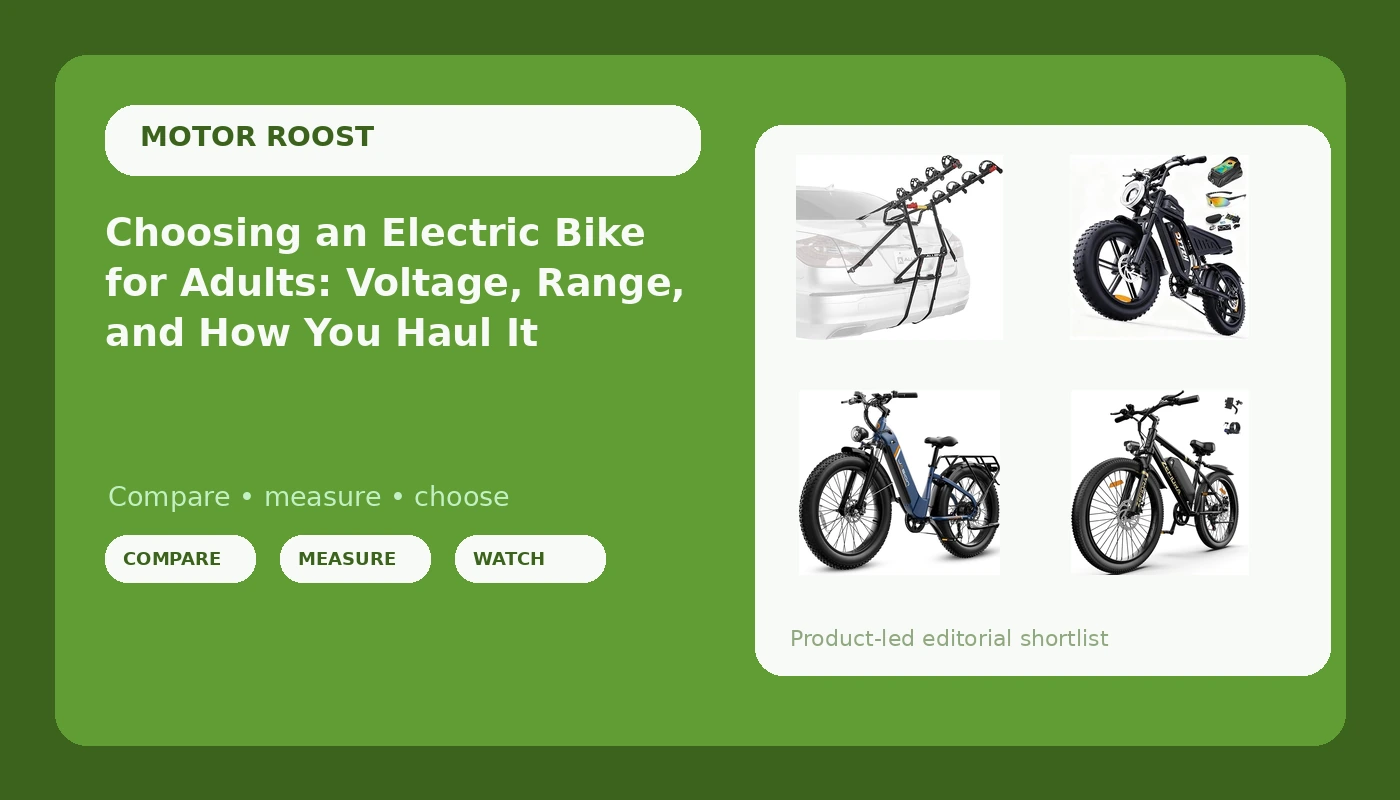
Work from voltage and watt-hours, not from a mileage claim. In this group, the F6 family lists the largest electrical system at 60V and 30Ah, the Jasion Thunder is the only model that states UL2849 certification along with a 400 lb capacity and 26-inch fat tires, and the mountain e-bike listing is the trail-focused option whose title does not publish electrical specs at all. The Allen Sports Premier 4-Bike Trunk Rack is not a bike. It is the piece of equipment that decides whether the second and third bikes in your garage ever leave the driveway.
4 useful options
| Model | Best fit | What stands out |
|---|---|---|
| F6/F6S/F6PRO Electric Bike for Adult with NFC | Riders who want the largest electrical system here | Lists a 60V 30Ah battery, a 4000/2000/1500W max motor rating across the family, and NFC unlocking |
| Jasion Thunder Electric Bike | Heavier riders and mixed pavement and dirt | Lists 1800W peak, 26-inch fat tires, an 864Wh battery, 400 lb capacity, and UL2849 certification |
| Electric Bike for Adults, Mountain E-bike for Off-Road & Trail Riding. | Trail and off-road riding | Positioned specifically as a mountain e-bike for off-road and trail use |
| Allen Sports Premier 4-Bike Trunk Rack, Model S104 | Getting bikes to the trailhead | Carries up to four bikes on a trunk-mounted rack |
The high-voltage pick: F6/F6S/F6PRO Electric Bike for Adult with NFC
Voltage is the first number worth looking at, and 60V sits at the top of the consumer range in this group. Multiply it out and a 60V 30Ah pack works out to roughly 1,800 watt-hours, which is a large battery by any standard. More voltage also means more electrical headroom, and that usually shows up as stronger acceleration and a higher sustainable speed than the same bike would manage at 48V. The trade-offs are weight and charging time. Because this page covers three trims, confirm which wattage rating applies to the version you select before comparing it to anything else.
The certified fat-tire pick: Jasion Thunder Electric Bike
Two things stand out beyond the motor rating. The first is UL2849 certification, which covers the electrical system of an e-bike and is the certification to look for if you plan to charge indoors. The second is the 400 lb capacity, well above what most adult e-bikes list, and it matters if you are a heavier rider or you carry cargo. The 864Wh pack is less than half the watt-hours of the 60V system above, and an 80-mile claim against 864Wh works out to roughly 11 watt-hours per mile, an efficient figure for a fat-tire bike with a high capacity rating. Treat that as a best case. Fat tires are their own trade: more grip and cushion on loose ground, more rolling resistance on pavement.
The trail pick: Electric Bike for Adults, Mountain E-bike for Off-Road & Trail Riding.
Mountain e-bikes live or die on suspension quality, tire width, gearing, and frame stiffness, and those are exactly the specs that rarely make it into a product title. When you open this listing, look for the voltage and amp-hour rating, whether the battery is removable, the suspension travel, and the frame size range. If a seller will not publish voltage anywhere on the page, that silence is information. A trail bike also has to handle your weight on a descent, so check the listed rider weight limit before you commit to it.
The transport pick: Allen Sports Premier 4-Bike Trunk Rack, Model S104
E-bikes are heavy, and that changes how you shop for a rack. Trunk racks hang bikes by the frame and carry a stated weight limit, and a four-bike rack built around pedal bikes is not automatically a two-e-bike rack. Check the rack's stated capacity against your bike's listed weight, then check whether your frame shape can hang safely at all. Step-through and full-suspension frames often need an adapter bar. Straps should land on metal where possible, not on plastic bumper covers or spoilers, and they need re-tightening after the first few miles. If most of your rides start at a trailhead, plan for this before you plan for a second battery.
Prices and availability may change. Product images, names, and retailer links are matched to verified listings. No current price, rating, stock status, or measured result is stated here without current evidence.
What voltage and wattage actually decide
Voltage sets the ceiling. A 48V system and a 60V system can both feel quick off the line, but the higher-voltage system has more headroom, and that typically shows up in sustained speed on flats and in how much torque the motor holds as the battery drains. Wattage describes how much power the controller will allow the motor to draw. Peak wattage is the number sellers advertise, and peak is a short burst, not a continuous figure. A bike listed at 1800W peak is not running 1800W for the length of your commute.
Battery capacity is what decides range, and it is written in amp-hours. Multiply volts by amp-hours and you get watt-hours, which is the honest way to compare two packs. The 60V 30Ah pack in the F6 family works out to about 1,800Wh. The Jasion Thunder's 864Wh pack is less than half that. Neither number is good or bad by itself, because a lighter bike with a smaller pack can go just as far as a heavier bike with a bigger one. What watt-hours buy you is the ability to run a bigger motor at a higher assist level for longer, which is exactly what a heavier rider on a hill needs.
One distinction worth holding onto: for most city riders, a removable battery is worth more than a slightly larger one, because it means indoor charging and cold-weather storage that does not punish the pack.
How to read a range claim before you buy
Range claims are the least reliable number on any e-bike page, and they are not lies so much as best cases. The formula is simple even when the inputs are not: watt-hours divided by consumption per mile equals range, and consumption depends on the rider, the terrain, the speed, and the assist level. Change any one of those and the same battery gives a different answer.
- Convert the pack to watt-hours. Multiply the listed voltage by the listed amp-hours. That is your total energy budget, and it is the only range input the listing actually gives you.
- Build your own consumption figure instead of trusting the claim. Track a few real rides at your weight and terrain, note the miles and the battery percentage used, and work out your watt-hours per mile.
- Adjust for rider weight. A 200 lb rider climbing a real hill draws more current than a lighter rider on flat ground, and the difference shows up in range, not on the spec sheet.
- Adjust for assist level and speed. Running the top assist mode for an entire ride costs dramatically more energy than a mid-level setting. If a range claim does not state the assist level, assume the lowest one.
- Check tire width and pressure. Fat tires cost range on pavement and give it back on loose ground, so match the tire to the surface you actually ride.
Getting the bike home, assembled, and out the door
- Assemble it yourself and check the stem, handlebar, seat post, and axle bolts before the first ride. A shop that assembles it for you cannot tell you which bolt was loose.
- Charge to full before the first ride, then charge in a fire-safe area away from anything flammable. A UL2849-listed electrical system is what to look for if indoor charging is your plan.
- Set the display to a low assist level for the first few miles. You are learning the brakes and the weight distribution, not chasing a top speed number.
- Weigh the bike and compare it against the rack's stated capacity before you load. On a trunk rack, put the heaviest bike closest to the vehicle and re-check the straps after a few miles.
- Expect to tune the bike after break-in. Cable stretch, brake pad bedding, and bolt settling are normal in the first hundred miles, and none of them are defects.
Which option should you choose?
Choose the F6/F6S/F6PRO Electric Bike for Adult with NFC when you want the largest electrical system in this group and you are willing to confirm which of the three listed motor ratings applies to the trim you buy. Choose the Jasion Thunder Electric Bike when certification, fat tires, and a high listed weight capacity matter more to you than raw watt-hours. Choose the Electric Bike for Adults, Mountain E-bike for Off-Road & Trail Riding. when your riding is genuinely off pavement and you are prepared to dig the voltage, suspension, and weight limits out of the full listing. Choose the Allen Sports Premier 4-Bike Trunk Rack, Model S104 when the bike has to travel by car to reach the ride, and check its stated weight capacity against your bike's listed weight before ordering.
Everything above comes from the product listings, not from measured testing. Voltage, amp-hours, wattage, certification, tire size, and capacity ratings are the seller's published figures, and the only way to confirm them is to read the current listing page. Range and speed claims in particular should be treated as best cases until you have your own numbers from your own roads.
The bottom line
The order of operations does not change: voltage and watt-hours first, certification and weight capacity second, and how you will transport the thing third. The F6 family carries the biggest electrical system here at 60V and 30Ah. The Jasion Thunder is the only listing that pairs UL2849 certification with fat tires and a 400 lb capacity. The mountain e-bike is the trail-focused option whose specs have to be dug out of the listing. And the Allen Sports Premier trunk rack is the unglamorous purchase that makes the other three useful beyond your own street. Check current Amazon price on each listing and compare the published specs against what you actually ride.