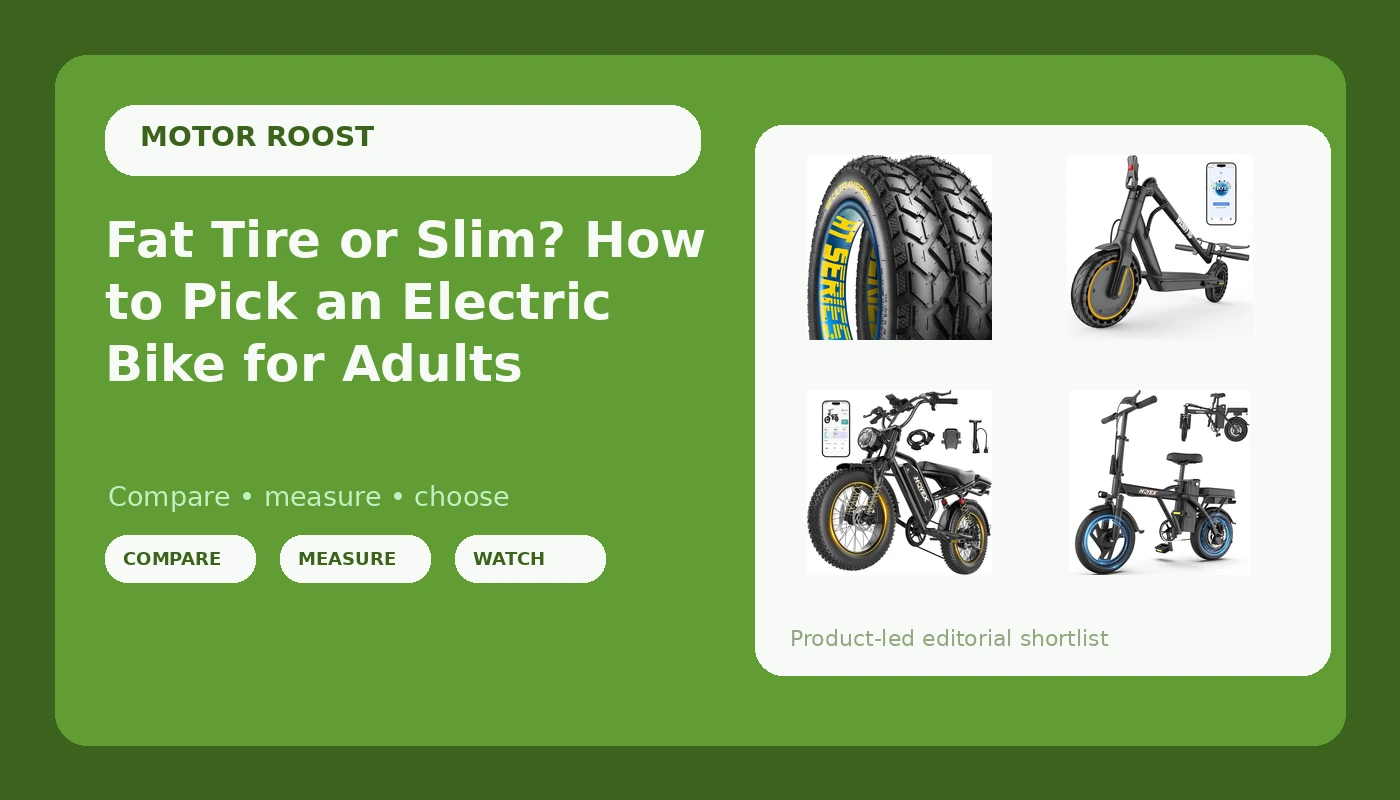
Most shoppers who go looking for an electric bike for adults start with a price filter and finish more confused than they began. The reason is that the numbers in these listings do not measure the same things. A 48V battery and a 500W motor describe an electrical system. A 20-inch wheel and a 26-inch wheel describe geometry. "Fat tire" describes a casing and tread width, and says nothing about where the bike will actually feel good.
Sort the category in this order instead: who is riding, where the bike gets stored, what surface it sees most, and how long a typical trip runs. Motor wattage, battery voltage, and tire width all follow from those four answers. This guide walks through four very different machines that cover most of that map, and explains the trade-off each one makes.
Related: How Battery Voltage Changes What an E-Bike Can Do →
Quick answer
Match the platform to the rider and the route before you compare wattage. The 20-inch fat tire model with the 1500W brushless motor, a 48V 20Ah battery, and dual suspension is the most complete mixed-surface package of the four, and the natural starting point if you want suspension travel and battery capacity in one bike. The multi-size 48V model covers riders who need a smaller frame or a tighter storage spot. The two-pack of 16x4.0 fat tire bikes suits a pair of riders or a compact-wheel build. The adult scooter with 350W or 500W options is the right answer when the trip is short and the storage is tighter still.
Four useful options
| Model | Best fit | What stands out |
|---|---|---|
| Electric Bike for Adults, 1500W Brushless Motor Ebike, 20" Fat Tire, 48V 20Ah, Dual Suspension | Mixed-surface riding and longer trips | 1500W brushless motor, 48V 20Ah battery, dual suspension, listed 31 MPH top speed |
| Electric Bike for Adults 14"/20"/26" Ebike 48V 500W/ 1500W | Riders who need a specific frame size | Three wheel sizes and two motor ratings in one listing |
| Ultraverse 16x4.0 E-Bike Fat Tire, All-Terrain Tread, 2 Units | Two riders, or a compact fat tire build | 16x4.0 fat tire with all-terrain tread, sold as two units |
| WERHY Adult Electric Scooter, 8.5''/10'' Solid Tire, 350W/500W | Short trips and tight storage | Solid tires in two diameters, two motor ratings, standing deck |
The mixed-surface pick: Electric Bike for Adults, 1500W Brushless Motor Ebike
Dual suspension is the detail that separates this one from the rest of the list. A fat tire already absorbs a lot of chatter on its own, and adding a rear shock on top of that changes what the bike does on washboard gravel, rooty singletrack, and the patched-and-repaved mess of a city bike lane. It is also the part that cheap bikes cheat on, and the part you notice on every single ride if it is done badly.
The trade-off is weight and footprint. A 20-inch fat tire bike with a 48V 20Ah battery is a substantial object to carry up stairs and to store. The listed 31 MPH top speed is a manufacturer figure, and top speed on any e-bike depends on rider weight, terrain, battery state, and which assist mode you are in. Treat it as the ceiling, not the average.
The size-flexible pick: Electric Bike for Adults 14"/20"/26" Ebike 48V 500W/ 1500W
Wheel size is the most underrated number in this whole category. A 26-inch wheel rolls over obstacles at a shallower angle and holds momentum better, which matters on long paved commutes. A 20-inch wheel is more compact and quicker to turn, which matters in traffic and on tight paths. A 14-inch wheel is a small-package bike, easier to lift and store, and noticeably twitchier at speed.
The same logic runs through the motor choice. A 500W rating on a 48V system is a commuter configuration, and the 1500W rating on the same voltage is a much more aggressive one. Pick the smaller wheel and the smaller motor for storage and errands, and the larger wheel and larger motor for distance and hills. Choosing the wrong combination here is the single most common reason people outgrow a first e-bike in a season.
The two-up pick: Ultraverse 16x4.0 E-Bike Fat Tire, All-Terrain Tread, 2 Units
A 4.0-inch section width is a genuine fat tire, and section width is what gives you the float and the cushioning that fat tires are famous for. The 16-inch diameter keeps the overall package small, which is why this size shows up on compact bikes, folding frames, and builds where a 20-inch or 26-inch wheel simply will not fit. All-terrain tread is the middle ground between a slick and a knobby, and it is the right call for a bike that splits time between pavement and hardpack.
Two units in one order is the practical detail. If you are building a pair of bikes, or keeping a matched spare so a flat does not sideline a ride, buying them together saves you the second shipping cycle and the second wait.
The scooter alternative: WERHY Adult Electric Scooter, 8.5''/10'' Solid Tire, 350W/500W
Solid tires are the honest differentiator. There is no tube to pinch and no air to lose, which removes the single most common reason a small-wheel machine ends up parked in a garage. The cost is ride quality: a solid tire transmits more of the road to your hands and feet than a pneumatic one, so the 10-inch option is the better pick if your route has rough pavement.
The bigger difference is the platform itself. Standing on a deck for a commute is a different physical experience than sitting on a saddle, and no spec sheet captures that. If your trip is two to five miles and your storage is a closet, a scooter is often the more sensible machine. If your trip is ten miles and includes a hill, it usually is not.
Prices and availability may change. Product images, names, and retailer links are matched to verified listings. No current price, rating, stock status, or measured result is stated here without current evidence.
What voltage and wattage actually tell you
Voltage sets the ceiling of the electrical system. All four bikes here run a 48V system, which is the mainstream adult e-bike standard and a meaningful step above the 36V systems found on cheaper and smaller machines. Higher voltage means the motor can be fed more power without pulling as many amps, which is why 48V has become the baseline for anything expected to move an adult at speed.
Wattage is the size of the motor, and it is where the marketing gets loud. A 500W rating and a 1500W rating on the same 48V system are two very different machines, and the difference shows up first on hills and second on acceleration. A 350W scooter motor and a 1500W bike motor are not in the same conversation at all, and comparing them by wattage alone misses the fact that one is pushing a 30-pound deck and the other is pushing a full bicycle plus a rider.
Battery capacity, measured in amp-hours, is the range number that actually matters. A 48V 20Ah pack stores more energy than a 48V 10Ah pack by a simple multiple, and more stored energy means more miles before the charger comes out. Range claims on a listing are usually generated by a light rider on flat ground in good weather, so discount them. The voltage and the amp-hours are the parts you can compare across listings with a straight face.
How to size a bike to a rider
- Start with wheel diameter. Choose 26-inch for distance, momentum, and paved commuting, 20-inch for a balance of compactness and stability, and 14-inch or 16-inch only when storage or transport space genuinely forces it.
- Pick the motor rating for your terrain, not for the spec sheet. A 500W system handles flat commutes; a 1500W system is for hills, heavier riders, and mixed surfaces.
- Check the battery in amp-hours and confirm the voltage. A 48V 20Ah pack is a long-range configuration, and a smaller pack on the same voltage is a shorter one.
- Decide whether you need suspension before you decide whether you need speed. A dual suspension frame changes rough-surface comfort more than another 200W of motor does.
- Measure your storage before you order. Wheel diameter and frame size, not motor wattage, are what determine whether a bike fits through the door and up the stairs.
What to check before you click buy
- Confirm the exact configuration, because listings that offer multiple wheel sizes or motor ratings ship one specific combination.
- Read the assembly requirement and set aside the time and the tools before the boxes arrive.
- Plan for the accessories you will actually want: a pump or a solid-tire plan, a lock rated for your area, and lights if the bike does not include them.
- Budget for the charger and the outlet location, especially if the battery is not removable on the model you choose.
- Check your local rules on where e-bikes and scooters are allowed, since motor wattage and top speed both affect classification in many places.
Which option should you choose?
Choose the Electric Bike for Adults, 1500W Brushless Motor Ebike when you want the most suspension, the biggest battery, and the widest tire in one bike, and when your rides mix pavement with gravel or trail. Choose the Electric Bike for Adults 14"/20"/26" Ebike 48V 500W/ 1500W when the deciding factor is fit, either because the rider is outside the average height range or because the storage space rules out a full-size frame. Choose the Ultraverse 16x4.0 E-Bike Fat Tire, All-Terrain Tread, 2 Units when you need two compact fat tires at once, or when a 16-inch wheel is the only diameter that fits your build or your space. Choose the WERHY Adult Electric Scooter, 8.5''/10'' Solid Tire, 350W/500W when your trips are short, your storage is tight, and you would rather never deal with a flat tire again.
One caveat runs across all four. These are listing specifications, not measured results. Top speed depends on rider weight and terrain, range depends on how much you use the motor, and ride comfort depends on suspension quality that a spec sheet cannot describe. Compare the numbers, then read the current owner feedback on the specific listing before you commit.
The bottom line
The right electric bike for adults is the one whose wheel size, motor rating, and battery capacity match the rider and the route, not the one with the biggest number on the page. A 48V 20Ah fat tire bike with dual suspension covers the most ground in this group. A multi-size 48V model covers the most riders. A pair of 16x4.0 fat tires covers the compact builds, and a solid-tire scooter covers the short trips that never needed a bicycle in the first place. Decide the surface and the storage first, and the wattage question answers itself.