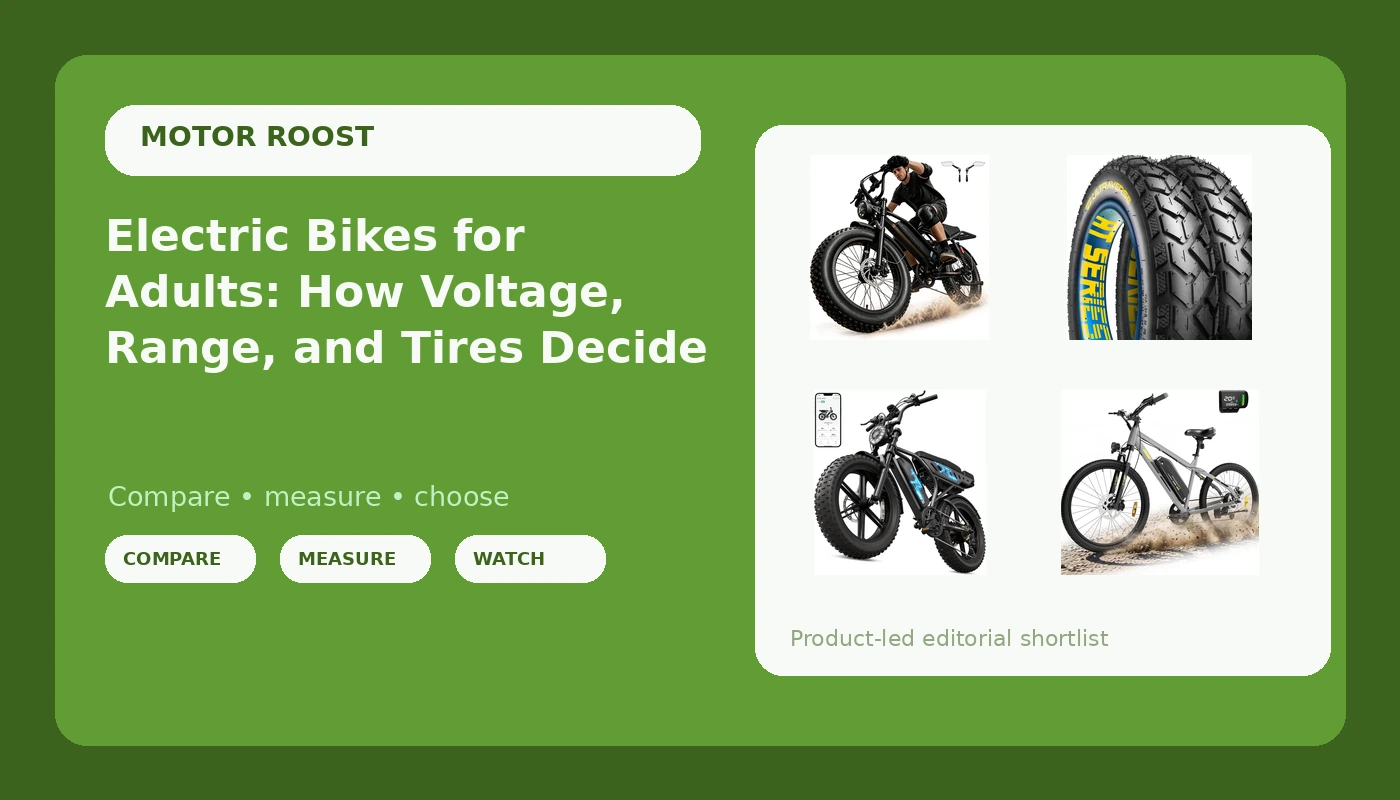
Most shoppers looking at electric bikes for adults hit the same wall. The listing is full of numbers, and none of them say whether the bike will still feel right in week three. Voltage, peak watts, claimed range, tire width, and battery capacity are the specs that shape a ride, and they do not all point the same direction. The four options below cover a 3000W peak long-range bike, a 48V urban model, a suspension commuter, and a fat-tire set, and each one answers a different question.
Related: How to Read an E-Bike Battery Spec Without Getting Fooled →
Quick answer
Match the bike to your daily distance and your hills before you compare anything else. If you want the most peak power and the longest claimed range in this group, start with the Jasion YR20Pro. If you want the most complete commuter package, with front suspension, 7-speed gearing, and a removable battery, the INVANTI is the more balanced build. The TST R9 is the 48V urban option, and the Ultraverse 16x4.0 set is a pair of tires for a bike you already own. There is no universal winner here, because the right answer depends on your route, your weight, and whether you can charge where you park.
4 useful options
| Model | Best fit | What stands out |
|---|---|---|
| Jasion YR20Pro Electric Bike,3000W Peak Motor,Max 90 Miles,5 Riding Modes | Riders who want maximum assist and the longest claimed range | 3000W peak motor, claimed maximum of 90 miles, five riding modes |
| INVANTI Electric Bike for Adults with 55 Miles, Peak 750W Motor, 20 MPH Commuting Electric Mountain Bike with 26" Tires, Front Fork Suspension, 7-Speed Gears, LCD Display and Removable Battery | All-round commuting with suspension and gears | 750W peak motor, 55 claimed miles, 20 MPH, 26" tires, front fork suspension, 7-speed gears, LCD display, removable battery |
| TST Electric Bike for Adults, 48V 15Ah Battery for Urban Cycling, R9 | City miles on a 48V platform | 48V 15Ah battery, urban cycling focus, R9 model |
| Ultraverse 16x4.0 E-Bike Fat Tire, All-Terrain Tread, 2 Units | Replacing or upgrading tires on an e-bike you own | 16x4.0 fat tire size, all-terrain tread, two units per order |
Long-range pick: Jasion YR20Pro Electric Bike,3000W Peak Motor,Max 90 Miles,5 Riding Modes
Peak watts are not the same as continuous watts, and that distinction matters more than any single number on a listing. A 3000W peak motor delivers that figure in bursts, usually under hard acceleration or on a climb, and settles to a lower continuous rating for normal cruising. That is still a lot of motor for a bike in this class, and it is the kind of headroom a heavier rider notices first. The 90-mile figure is a claimed maximum, which means the top of a range rather than a guarantee. Treat it as a ceiling reached with a light rider, low assist, flat ground, and warm weather. Five riding modes give you a way to dial assist down on the days you want the miles and up on the days you want the speed.
Commuter all-rounder: INVANTI Electric Bike for Adults with 55 Miles, Peak 750W Motor, 20 MPH Commuting Electric Mountain Bike with 26" Tires, Front Fork Suspension, 7-Speed Gears, LCD Display and Removable Battery
Suspension is where cheap bikes cheat, and it is the first thing I look at on a commuter. A front fork that actually absorbs hits keeps your hands and spine out of the fight on cracked pavement and gravel shoulders, while a stiff one passes every bump straight through. Gears matter for the same reason on a different axis: 7-speed gearing lets you keep pedaling at a comfortable cadence when the motor is doing less of the work, which is how you stretch a battery. The removable pack is the quiet feature that decides a lot of purchases. If you park on the street or live on a third floor, carrying the battery to an outlet beats carrying the whole bike.
48V urban option: TST Electric Bike for Adults, 48V 15Ah Battery for Urban Cycling, R9
Run the arithmetic and the TST's pack comes out at 720 watt-hours, since 48 volts multiplied by 15 amp-hours equals 720. That is a straightforward way to compare batteries across listings that use different marketing language. Watt-hours tell you the size of the tank; the motor and your right hand decide how fast you drain it. A 48V system also tends to run cooler and pull less current for the same output than a lower-voltage setup, which is one reason 48V has become the default for adult commuter bikes. What the listing does not spell out is cell manufacturer, and that is the spec I care about most. If a seller will not name the cells, I assume the worst.
Tire upgrade: Ultraverse 16x4.0 E-Bike Fat Tire, All-Terrain Tread, 2 Units
Tire width changes a ride more than most buyers expect. A 4.0-inch fat tire runs at low pressure, floats over sand, snow, and loose gravel, and softens washboard surfaces that would rattle a narrow tire. The trade is rolling resistance and weight, plus a little more steering effort at low speed. All-terrain tread sits in the middle: enough bite for dirt and grass, not so aggressive that pavement turns into a drone. Before ordering any tire, check two things on your own bike, the rim width and the frame clearance at the chainstays and fork. A tire that fits the rim can still rub the frame, and a pair you cannot mount is not a deal.
Prices and availability may change. Product images, names, and retailer links must be matched by verified ASIN. Do not state a current price, rating, stock status, or measured result without current evidence.
What voltage and peak watts actually tell you
Voltage describes the electrical pressure of the system, and amp-hours describe how long the pack can sustain a given current. Multiply them and you get watt-hours, the closest thing to a fuel gauge in an e-bike listing. A 48V 15Ah pack holds 720 watt-hours. A 52V pack of the same amp-hour rating holds more, which is why voltage-first shoppers cross-shop 48V, 52V, and 60V before they ever look at a price tag.
Peak watts describe the maximum the controller will allow in a burst. Continuous watts describe what the motor can handle all day. Listings usually advertise the peak number because it is bigger, so a 3000W peak motor and a 750W peak motor are not as far apart in normal riding as the numbers suggest. What separates them in practice is heat management and how much assist is left when the battery is half empty.
Battery cells are the third variable, and the one sellers hide most often. Branded cells from a known manufacturer hold their capacity longer and sag less under load than unbranded equivalents. If a listing names the cell brand, that is a meaningful signal. If it does not, you are buying an unknown.
How to compare range claims
Every claimed maximum range assumes a light rider, low assist, flat terrain, mild weather, and a fresh pack. Change any one of those and the number drops. Heavier riders lose range first, because the motor works harder on every acceleration and every climb. Cold weather cuts usable capacity. Fat tires add rolling resistance. Headwinds are the silent range killer that no spec sheet mentions.
That does not make claimed range useless. It makes it a ceiling. Compare claims against each other, then discount the one you pick based on how you actually ride.
- Estimate your real daily distance, then round up by about a third for detours, wind, and cold mornings.
- Convert each candidate battery to watt-hours so you are comparing the same unit across listings.
- Check peak watts against the steepest hill on your route, not the flattest.
- Decide whether the battery needs to come inside with you, since that rules some bikes out entirely.
- Confirm tire size, suspension, and gearing match the surfaces and grades you ride most.
What to check before you buy
- Assembly time and tools: heavier frames go together faster with a second pair of hands and a torque wrench.
- Bike weight: motor size does not help you carry 60 pounds up a stairwell, and that is a daily cost.
- Brakes and tires: the parts that stop you deserve as much attention as the part that moves you.
- Charging location: a removable pack changes where you can park and charge, and a fixed one locks you in.
- Local rules: know your class limits and whether the bike arrives speed-limited out of the box, and whether that limit can be adjusted.
Which option should you choose?
Choose the Jasion YR20Pro Electric Bike,3000W Peak Motor,Max 90 Miles,5 Riding Modes when you want the most peak power and the longest claimed range in this group and your rides regularly run long. Choose the INVANTI Electric Bike for Adults with 55 Miles, Peak 750W Motor, 20 MPH Commuting Electric Mountain Bike with 26" Tires, Front Fork Suspension, 7-Speed Gears, LCD Display and Removable Battery when you commute daily on mixed pavement and want suspension, gears, and a battery you can carry indoors. Choose the TST Electric Bike for Adults, 48V 15Ah Battery for Urban Cycling, R9 when you want a 48V platform and your miles are mostly city streets. Choose the Ultraverse 16x4.0 E-Bike Fat Tire, All-Terrain Tread, 2 Units when you already own a 16-inch fat-tire bike and need fresh rubber rather than another bike.
One caveat applies to all four. Every figure in this article comes from the product listings, not from a measured test, and claimed range and top speed vary with rider weight, terrain, assist level, and temperature. Verify the specs that matter most to you on the current listing before you commit.
The bottom line
There is no single right answer among these four, because they are not all the same kind of product. The Jasion YR20Pro leads on motor size and claimed range, the INVANTI is the most fully equipped commuter, the TST R9 is the 48V urban pick, and the Ultraverse set is a maintenance item for a bike already in your garage. Start with your daily distance, your steepest hill, and where the battery will charge, then pick the option that matches those three answers. Voltage and watt-hours first, price second.