Electric bike speed and range are the two numbers every listing leads with, and the two numbers that mean the least on their own. A bike advertised at 25 mph and a bike advertised at 37 mph are not twelve miles per hour apart in real life. They are two different machines built for two different jobs, with different motor peaks, different batteries, and different ideas about who is going to ride them. I spent eight years turning pedals for a living in Denver before a motor entered the picture, and the lesson from those years still holds: a spec sheet tells you what a bike is trying to be, not what it does under a 200 pound rider on a real hill in real weather. This guide breaks down how to read speed and range claims, and where four very different options actually fit.
Related: E-Bike Battery Cells Explained: Why LG Packs Change the Range Math →
Quick answer
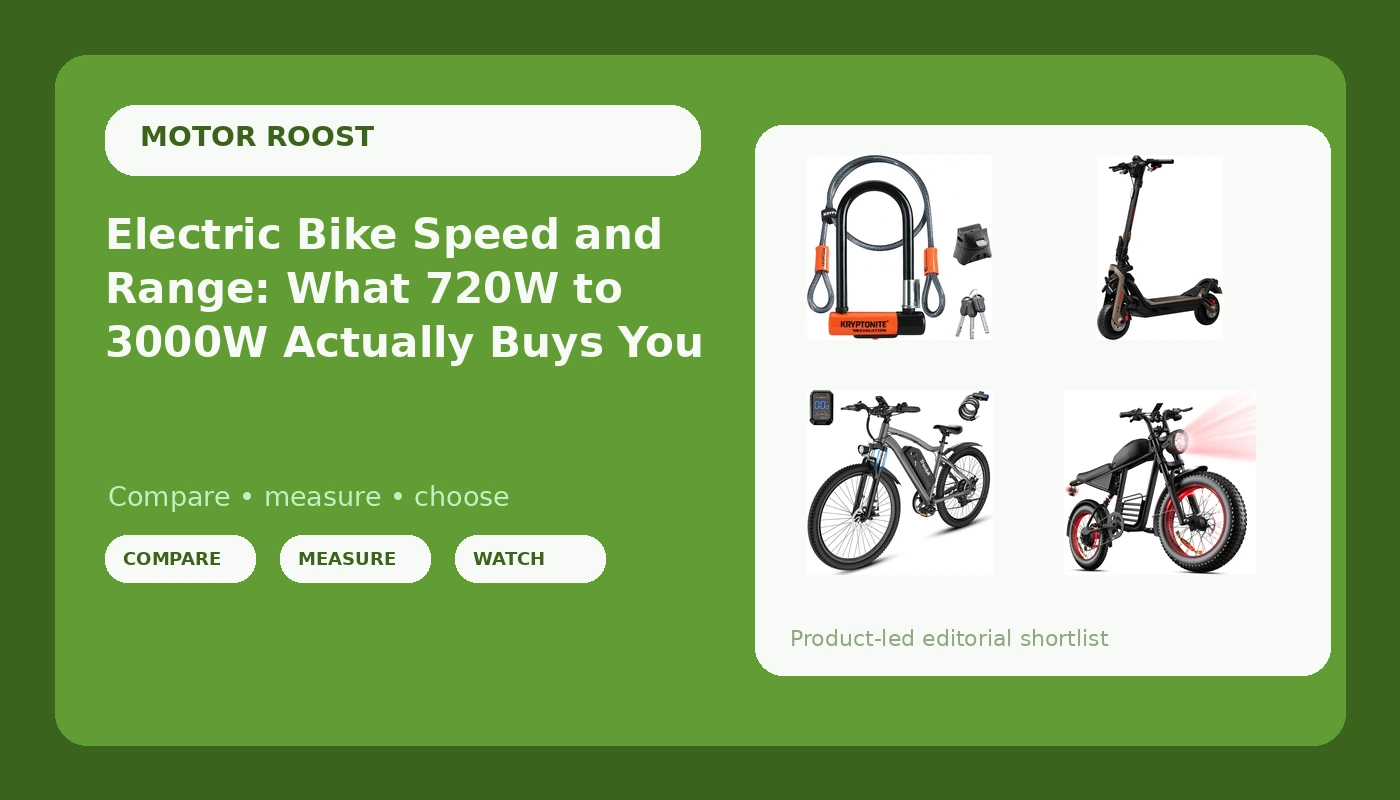
The FX20 is the higher speed option of the two e-bikes here, listed at 3000/1500/1000W peak with a 30 to 37 mph range. The 26 inch commuter is the practical distance option, with a 720W motor, a 375Wh battery, and a claimed 50 mile range. The Segway SuperScooter GT3 Pro is not an e-bike at all: it is a standing scooter listed at up to 50 mph and an 86 mile range, which puts it in a separate category for both speed and where you can legally ride it. The Kryptonite Evolution Mini-7 is the lock that keeps whichever one you buy from becoming someone else's. Match the machine to the trip before you match it to the sticker.
4 useful options
| Model | Best fit | What stands out |
|---|---|---|
| Electric Bike for Adults FX20, 3000/1500/1000W Peak 30-37MPH Fast | Riders who want the highest listed top speed of the two e-bikes here | 3000W peak motor listing and a 30 to 37 mph speed range |
| Electric Bike for Adults, 26" Commuter Ebikes with 5-Level Pedal Assist & 7-Speed Gears, 25MPH, 720W Motor, 375Wh Battery, 50 Miles, Lockable Suspension Fork, Lightweight Electric Mountain Bicycles | Daily commuting and mixed pavement and trail riding | 720W motor, 375Wh battery, 5-level pedal assist, 7-speed gearing, lockable suspension fork |
| Segway SuperScooter GT3 Pro Electric Scooter, Up to 50 MPH, 86-Mile Range | Riders who want maximum speed and range without pedaling | Listed at up to 50 mph and an 86 mile range |
| Kryptonite Evolution Mini-7 Bike U-Lock, 13mm Steel Shackle, 4 ft Cable | Locking up any of the above in a city or on a campus | 13mm steel shackle with a 4 ft cable included |
The higher speed e-bike: Electric Bike for Adults FX20, 3000/1500/1000W Peak 30-37MPH Fast
The trade-off with a bike built around peak wattage is that peak wattage is a moment, not a habit. Three power numbers on one listing usually mean the motor can hit its highest figure briefly under load, hold a middle figure for sustained climbing, and cruise at the lowest. That is fine if your route includes a steep pitch you want to attack. It is less useful if your route is 20 miles of flat bike path, where the bigger motor mostly costs you battery. Read the speed band as a range, not a promise, and remember that the top of any band assumes a lighter rider than you on flat ground with a tailwind.
The commuter value pick: Electric Bike for Adults, 26" Commuter Ebikes with 5-Level Pedal Assist & 7-Speed Gears, 25MPH, 720W Motor, 375Wh Battery, 50 Miles, Lockable Suspension Fork, Lightweight Electric Mountain Bicycles
The 375Wh battery is the number that decides whether this bike fits your life. Watt hours are simply voltage multiplied by amp hours, and they describe the size of the tank. A 25 mph bike drawing on a 375Wh pack is going to travel a very different distance at assist level 1 than at assist level 5, and the claimed 50 miles almost certainly describes the gentle end of that scale. That is not a knock. It is how every e-bike range figure on the market is produced. The lockable suspension fork matters more than it sounds, because a fork that can be locked out stops bobbing when you are climbing on pavement and absorbs hits when you drop onto gravel. If you want one bike for a commute and a weekend trail, this is the shape that does both.
The scooter alternative: Segway SuperScooter GT3 Pro Electric Scooter, Up to 50 MPH, 86-Mile Range
An 86 mile range claim on a scooter deserves the same skepticism as a 50 mile claim on a bike, plus one extra question: at what speed? Range and speed pull against each other on any battery powered machine, and a scooter that claims 50 mph and 86 miles is describing two different rides, not one. The real reason to consider a scooter over an e-bike is not the numbers. It is that you fold a scooter, carry it up stairs, and store it under a desk, and you do not do any of those things with a 26 inch e-bike. The reason not to consider one is that pedals give you a fallback when the battery is empty and a scooter gives you a walk. Class rules for scooters also vary by city and state, so check your local rules before you assume you can ride 50 mph anywhere you like.
The security pick: Kryptonite Evolution Mini-7 Bike U-Lock, 13mm Steel Shackle, 4 ft Cable
The mistake people make with e-bike security is locking the frame and nothing else. A U-lock around the frame and a rack is the primary defense, and the 4 ft cable is what lets you include a wheel or a second anchor point without carrying a second lock. Do not treat the cable as the main lock. Cables are cut, shackles are cut with more effort, and the whole point of a two part setup is that a thief has to defeat the harder half. Whatever you buy, lock it the same way every time, in the same place, so that a bike that lives outside becomes a bike nobody bothers with.
Prices and availability may change. Product images, names, and retailer links must be matched by verified ASIN. Do not state a current price, rating, stock status, or measured result without current evidence.
How e-bike speed ratings actually work
A single wattage number on an e-bike listing is close to meaningless. The FX20 lists three: 3000, 1500, and 1000W. That pattern shows up across the fast end of the market because electric motors have two relevant outputs. There is peak output, the short burst a motor can produce when you ask for everything at once on a climb or from a standstill, and there is continuous output, the level the motor can hold without overheating on a long ride. A bike that advertises 3000W peak is not a 3000W bike in the way a light bulb is a 60W bulb. It is a bike that can spike to 3000W and will spend most of its life well below that.
Top speed works the same way. The 30 to 37 mph band on the FX20 and the 25 mph figure on the commuter are both manufacturer claims, and both are produced under conditions that favor the number: a lighter rider, flat ground, a full charge, and the highest assist setting. The variables that move real world speed are rider weight, tire pressure, wind, grade, and state of charge. A 200 pound rider into a headwind on a 12 percent grade is running a completely different test than the one that produced the sticker. That is not a reason to distrust a specific brand. It is a reason to compare bikes on the parts of the spec sheet that are hard to fudge, like gearing, wheel size, and battery capacity.
Why range claims need a second number
Range is a function of battery capacity divided by how hard you ride. The commuter here gives you 375Wh, which is the honest starting point for any conversation about how far it goes. The Segway lists 86 miles, which is a range figure without a stated capacity attached to it in the product name, and that is exactly the kind of number you should treat as a ceiling rather than an average. When a listing gives you watt hours, you can reason about range yourself. When it only gives you a mileage claim, you are trusting the same marketing department that picked the best case weather for the test ride.
There is also a temperature story, and it matters in places like Denver. Battery packs deliver less usable capacity in the cold, which is why a bike that feels unstoppable in July feels noticeably weaker in January. Cold weather range loss is normal chemistry, not a defect, and it is the single biggest reason a commuter should buy more battery than the math says they need. If your round trip is 15 miles, plan around a bike that claims 30, not one that claims 16.
- Measure your actual round trip distance, then add the detour you always take, and shop against that number rather than the number in the ad.
- Decide which figure you care about more, because the FX20 and the commuter here trade top speed against battery capacity and gearing.
- Match the motor to your weight and your terrain, not to the sticker, and treat peak wattage as a burst rather than a cruising figure.
- Read the battery spec in watt hours and check whether the listing names the cell brand and whether the pack comes out for charging.
- Budget for the lock, a helmet, and a first tune up before checkout, not after the bike is sitting in your hallway.
What to check before you buy
- Ride the assist level you actually plan to use. A demo on level 1 tells you nothing about a commute on level 5.
- Compare watt hours, not range claims, when you are cross shopping two bikes at different prices.
- Weigh the storage question early. A 26 inch e-bike and a folding scooter solve the same problem in completely different ways.
- Buy the lock with the bike. A U-lock with a cable covers the frame and at least one wheel.
- Plan for assembly and a break in period. Cables stretch, brakes bed in, and bolts settle in the first few rides.
- Verify the rules where you ride. Speed limits for e-bikes and scooters are set locally, and they do not match the top speed on the box.
Which option should you choose?
Choose the Electric Bike for Adults FX20, 3000/1500/1000W Peak 30-37MPH Fast when the higher end of the speed band is the whole point and you are willing to accept a bike that is built around motor output rather than around a stated battery capacity.
Choose the Electric Bike for Adults, 26" Commuter Ebikes with 5-Level Pedal Assist & 7-Speed Gears, 25MPH, 720W Motor, 375Wh Battery, 50 Miles, Lockable Suspension Fork, Lightweight Electric Mountain Bicycles when you want a real commuter with stated battery capacity, gearing you can pedal, and a suspension fork that locks out for pavement and opens up for trail.
Choose the Segway SuperScooter GT3 Pro Electric Scooter, Up to 50 MPH, 86-Mile Range when you want the highest claimed speed and range in this group and you need something that folds instead of something you pedal.
Choose the Kryptonite Evolution Mini-7 Bike U-Lock, 13mm Steel Shackle, 4 ft Cable regardless of which of the other three you pick, because a fast bike with a cheap lock is a donation.
The caveat that applies to all of it: every speed and range figure in this article is a manufacturer claim taken from the product listing, not a measured result, and none of it was produced under your weight, your terrain, or your weather. Use the claims to narrow the field, then use the parts of the spec sheet that cannot be fudged to make the call.
The bottom line
Speed and range are the headline numbers and the last numbers you should trust. What you can actually compare is battery capacity in watt hours, gearing, wheel size, assist levels, and the type of machine you are buying, because a scooter and an e-bike are not competing for the same trip. If your commute is the priority, the 26 inch commuter gives you the most transparent set of specs to plan around. If speed is the priority, the FX20 posts the bigger motor and the higher speed band, and you should go in knowing what a peak rating means. If you want to fold it and forget it, the GT3 Pro is the outlier that does something the bikes cannot. And whichever one follows you home, budget for the lock in the same purchase, because the Kryptonite Evolution Mini-7 is the difference between a bike you own and a bike you used to own.