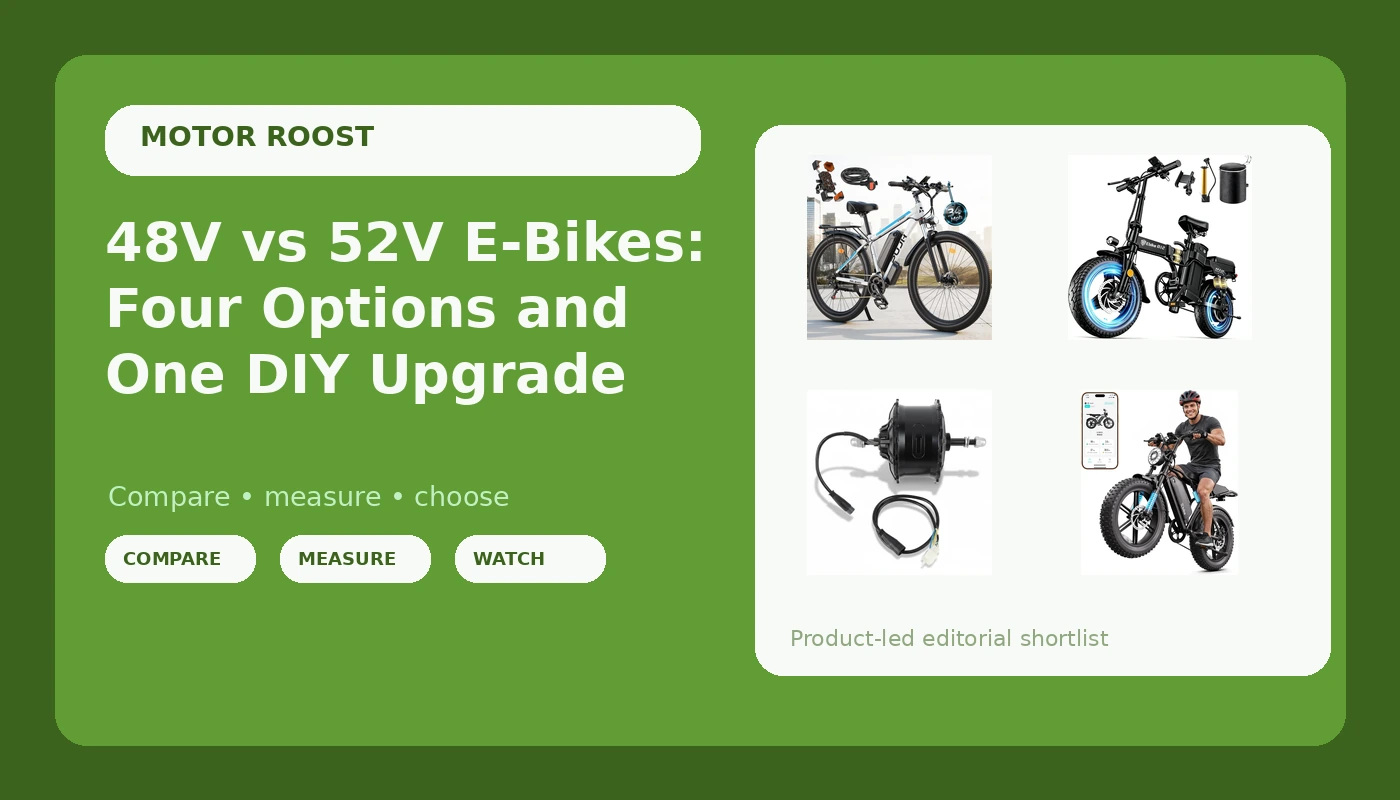
Most e-bike listings lead with wattage, because wattage is the biggest number on the page. Voltage is the number that actually decides how the bike feels underneath you, and amp-hours decide how long it keeps feeling that way. This explainer is about what 48V vs 52V e-bikes means in practice, how wheel and tire size change a ride more than most buyers expect, and where a single replacement part fits when the smarter move is fixing the bike you already own instead of replacing it. I ride in Denver, I weigh close to 200 pounds, and the bikes that stay in my garage are the ones that still work after a hard week. Specs are where the conversation starts, not where it ends.
Related: How E-Bike Battery Voltage Changes Range, Speed, and Hill Climbing →
Quick answer
Voltage sets the ceiling and amp-hours set the distance. The 48V bikes in this group pair with packs rated 15Ah to 17.5Ah, while the folding model offers a 52V 25Ah configuration, the largest energy reserve of the four on paper. Wattage describes peak pull: two complete bikes here list 2000W peak, the folding model lists 2000W and 1000W depending on configuration, and the replacement hub motor is rated 48V 750W. No single number makes one of these better than another. Match the machine to the job: fat tires and a removable pack for mixed pavement and dirt, a 29-inch platform for longer off-road days, a folding frame when storage is tight, and a hub motor when the bike you already own is worth repairing.
Four useful options
| Model | Best fit | What stands out |
|---|---|---|
| Electric Bike for Adults,2000W Peak,20"x4"Fat Tire,48V Removable Battery | Mixed pavement, dirt, and daily errands | 20 by 4 inch fat tires paired with a 48V pack that lifts off the frame |
| 2000W Ebike 48V 17.5Ah 29" Electric Bike Max 80Mi for Off-Road Adults | Longer off-road rides and taller riders | 29-inch wheels and the largest listed range claim of the group |
| A12/A12S Foldable Ebike with Keyless Ignore, 2000/1000W, 52V 25Ah/48V 15Ah | Apartments, car trunks, mixed commutes | Folding frame with a 52V 25Ah configuration option |
| Electric Bike Replacement Hub Motor, Aluminum Alloy IP65 Rainproof 48V 750W 9Pins Rear Drive Wheel Motor with 170 to 175mm Opening for Electric Bikes Modification DIY | Repairing or rebuilding an existing bike | IP65 rain rating and a defined 170 to 175mm dropout opening |
The fat tire all-rounder: Electric Bike for Adults,2000W Peak,20"x4"Fat Tire,48V Removable Battery
The trade-off with a 20-inch fat tire bike is geometry. You get a lower standover and a planted feel on loose surfaces, and you give up some rollover ability and top-end efficiency compared with a larger wheel. If your riding is a mix of bike path, gravel shoulder, and the occasional dirt shortcut, that trade is usually worth it. If your commute is 15 miles of smooth pavement each way, a bigger wheel will feel easier over the same distance.
The long-range off-road build: 2000W Ebike 48V 17.5Ah 29" Electric Bike Max 80Mi for Off-Road Adults
Range claims deserve a hard look, and the 80-mile figure is a maximum, not an average. Max range usually assumes a lighter rider, a low assist level, flat ground, and no headwind. The useful way to read it is as a comparison: 48 volts times 17.5 amp-hours works out to roughly 840 watt-hours of stored energy, which is more than the 48V 15Ah configuration of the folding bike and less than its 52V 25Ah configuration. That is math from the listed specs, not a promise about your commute.
The folding option: A12/A12S Foldable Ebike with Keyless Ignore, 2000/1000W, 52V 25Ah/48V 15Ah
This is where the voltage question gets interesting. The 52V 25Ah option works out to roughly 1300 watt-hours, a big step up from the 48V 15Ah option at roughly 720 watt-hours. More voltage also means the motor can spin faster for the same current, which is why 52V systems tend to feel quicker off the line. The cost is weight and, on a folder, stiffness. Folding frames flex more than rigid ones by design, and a heavier pack makes that more noticeable. Pick the 52V version for distance and punch, the 48V version for a lighter, simpler bike.
The DIY part: Electric Bike Replacement Hub Motor, Aluminum Alloy IP65 Rainproof 48V 750W 9Pins Rear Drive Wheel Motor with 170 to 175mm Opening for Electric Bikes Modification DIY
A hub motor is the least glamorous product in this article and, for some riders, the most useful. If a rear motor has failed, or you want to convert a pedal bike you already like, swapping the motor is cheaper than a new bike and keeps a frame you have already dialed in. The catch is compatibility. The 170 to 175mm opening has to match your frame, the 9-pin connector has to match your controller harness, and the controller and battery have to be rated for 48V. Measure before you order, because a hub motor that does not fit is a paperweight with spokes.
Prices and availability may change. Product images, names, and retailer links are matched to verified listings. No current price, rating, stock status, or measured result is stated here without current evidence.
What voltage and amp-hours actually decide
Voltage is the ceiling on how fast the motor can turn, and it is why a 52V system generally feels livelier than a 48V one with the same wattage rating. Wattage is the flow: a 2000W peak rating means the motor can pull that much briefly, usually on acceleration or a climb, not continuously for the whole ride. Amp-hours are the size of the tank, and multiplying voltage by amp-hours gives you watt-hours, the only number that compares packs fairly across different voltages.
That is why 52V 25Ah and 48V 17.5Ah are not close, even though both look like big batteries. Roughly 1300 watt-hours against roughly 840 is a real gap. It is also why a 48V 15Ah pack at roughly 720 watt-hours will feel like the shortest leash of the group. None of this tells you which bike is right, because a lighter rider on flat ground can stretch a small pack further than a heavy rider on hills stretches a big one.
Wheel size, dropouts, and parts compatibility
Wheel diameter changes how a bike handles obstacles and how efficiently it rolls. A 29-inch wheel rolls over ruts and roots with less input, which is why the off-road build uses that size. A 20-inch fat tire trades rollover for flotation and a lower center of gravity, which is the appeal of the fat tire model. Neither is faster in the abstract; they are faster on different surfaces.
If you are buying a part instead of a bike, the mechanical interface matters more than any spec sheet number. The replacement hub motor lists a 170 to 175mm opening, which is the width of the rear frame where the axle sits. Measure yours with the wheel out. Then confirm the connector type and the controller voltage. A 9-pin plug that does not match your harness means splicing, and a 48V motor on a 52V battery is a conversation you do not want to have with a controller.
- Set your voltage target first, 48V or 52V, because the battery, controller, and motor have to agree.
- Convert amp-hours to watt-hours by multiplying voltage times amp-hours, then compare packs on that number.
- Match wheel and tire size to your surface: fat and small for loose ground, tall and narrow for distance and rollover.
- For any replacement part, measure the frame interface and confirm the connector before ordering.
- Budget assembly and tuning time, because nothing arrives dialed in the way you want it.
Before you add it to the cart
- A removable battery is worth more than a bigger battery if you park outside or live upstairs.
- Fat tires run at low pressure, so check pressure often and carry a pump that can move real volume.
- An IP65 rating covers rain spray and splashes, not river crossings or a hose aimed at the hub.
- Folding frames trade stiffness for storage; check the hinge and latch on arrival, not after a month.
- A hub motor swap is a controller and battery project, not just a wheel project, so price the whole system.
Which option should you choose?
Choose the Electric Bike for Adults,2000W Peak,20"x4"Fat Tire,48V Removable Battery when you want one bike that handles pavement, gravel, and dirt without thinking about it, and you want to carry the battery inside. Choose the 2000W Ebike 48V 17.5Ah 29" Electric Bike Max 80Mi for Off-Road Adults when your riding leans off-road and you want the rolling efficiency of a larger wheel with the biggest 48V pack here. Choose the A12/A12S Foldable Ebike with Keyless Ignore, 2000/1000W, 52V 25Ah/48V 15Ah when storage or transport is the limiting factor, and go for the 52V configuration if range and punch matter more than weight. Choose the Electric Bike Replacement Hub Motor when the frame you already own is solid and only the motor is the problem.
The honest limitation on all of this is that listed specs describe the machine, not your ride. Range depends on rider weight, terrain, assist level, and temperature, and the only way to know your real number is to track your own miles. Treat every maximum range claim as a ceiling, not an average.
The bottom line
The 48V vs 52V question comes down to what you are optimizing for. A 48V system with a 17.5Ah pack is a known, serviceable platform with plenty of energy for most riders. A 52V system with a 25Ah pack gives you more headroom for speed and distance at the cost of weight. The fat tire bike is the generalist, the 29-inch bike is the off-road platform, the folder is the space-saver, and the 48V 750W hub motor is the fix for a bike that is otherwise fine. Pick the one that matches your surface, your storage, and your hill, and check current Amazon price and availability before you commit, because listings move faster than spec sheets do.