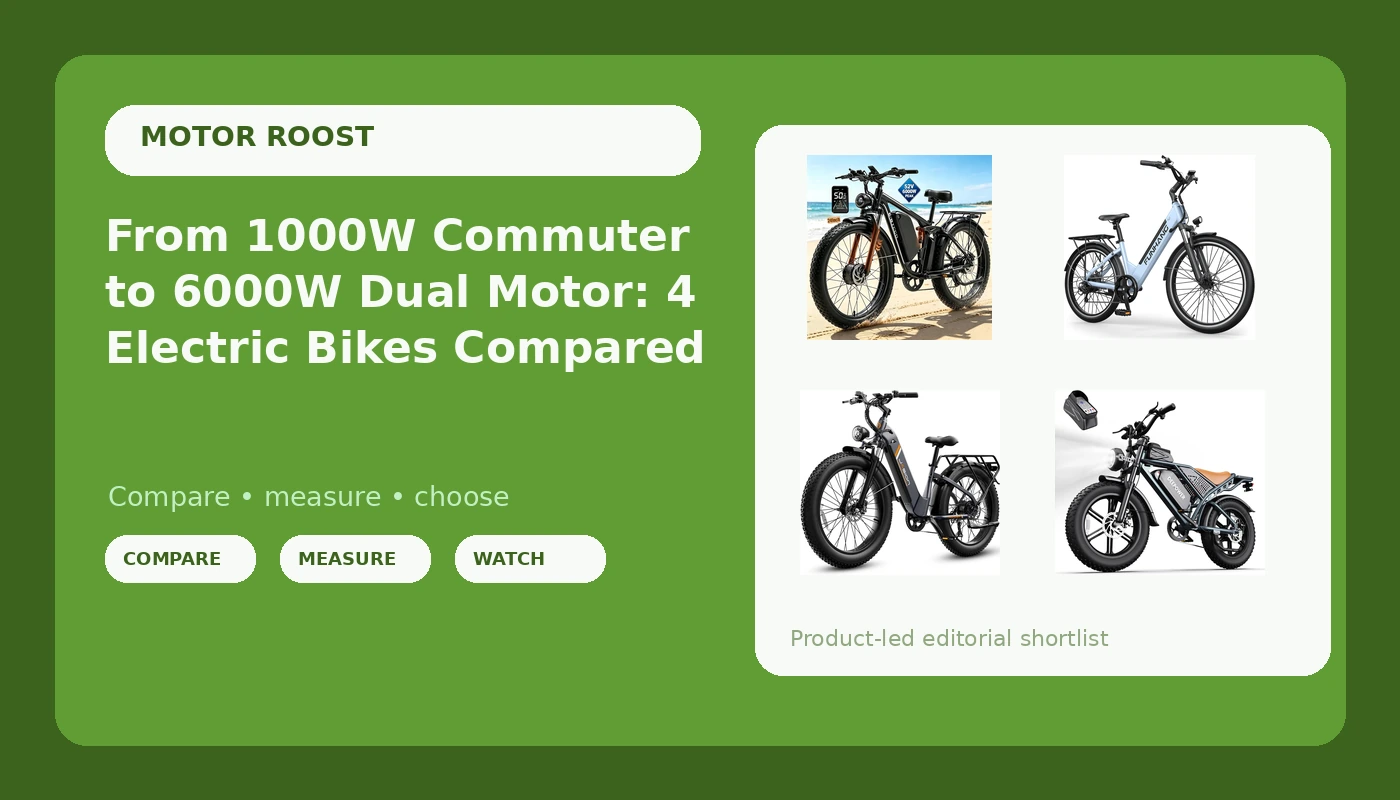
I rode a fixie 40 miles a day for eight years as a Denver messenger before my knees filed a complaint I couldn't argue with. Electric bikes for adults were the compromise, and three years later I own three, commute on one daily, and I'm already shopping for a fourth. In that time I've learned that a spec sheet is a sales document, not a review. It tells you what the seller hopes you'll focus on. It almost never tells you what breaks first.
So when I line up four Amazon e-bikes side by side, I'm not ranking them by the biggest number on the listing. I'm ranking them by what the number actually buys you: voltage, battery capacity, brakes, suspension, weight rating, and whether the seller is willing to name the certification and the cell manufacturer. Those are the things I cross-shop before I ever look at what a bike costs.
The short answer: if you want one bike to do commuting and weekend trail duty, the Jasion Thunder is the best balance here. If top speed and long trail days are the whole point, the E·Bycco dual motor is in a class by itself. The 2000W moped is the range wildcard, and the Funhang step-thru is the cheapest honest way into the hobby.
That's the summary. The reasoning takes longer, because three of these bikes are answering three different questions.
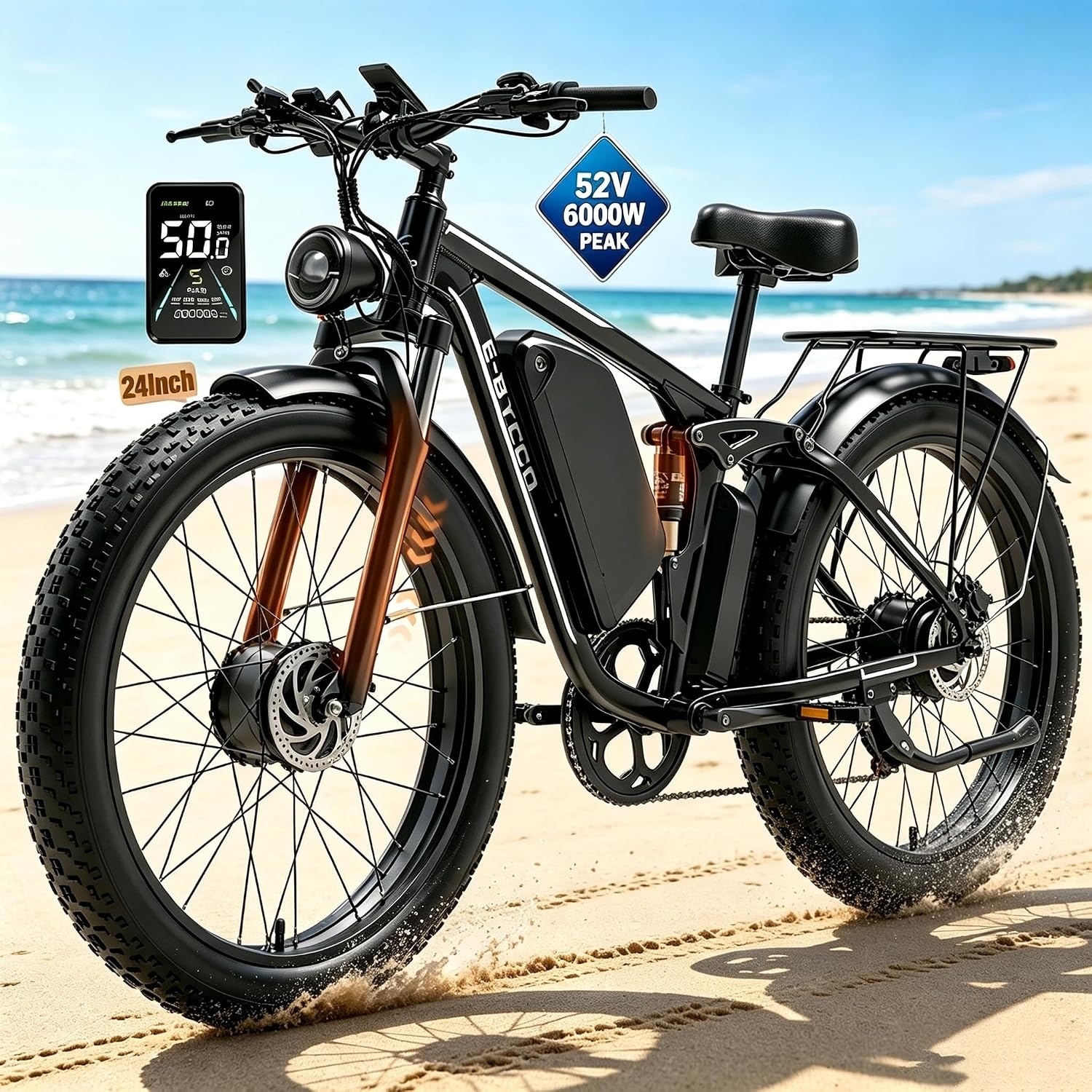
E·Bycco 6000W/9000W Peak Dual Motor
52V 32AH pack, 6000W/9000W peak dual motor, full suspension, hydraulic brakes, 50 MPH and 110-mile range claims, 24"/26" fat tires
Heaviest and most complex bike here. Two motors and two controllers mean more to maintain, and fat tires are not what you want on a daily commute
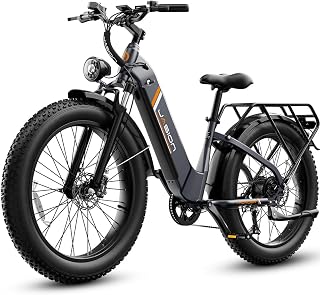
Jasion Thunder 1800W Peak Fat Tire
1800W peak, 864Wh battery, 80-mile range claim, 30+ MPH, 400 lb capacity, UL 2849 certified, 26" fat tires
The listing doesn't claim hydraulic brakes or full suspension, and 48V-class power can feel flat on a long climb with a heavy rider
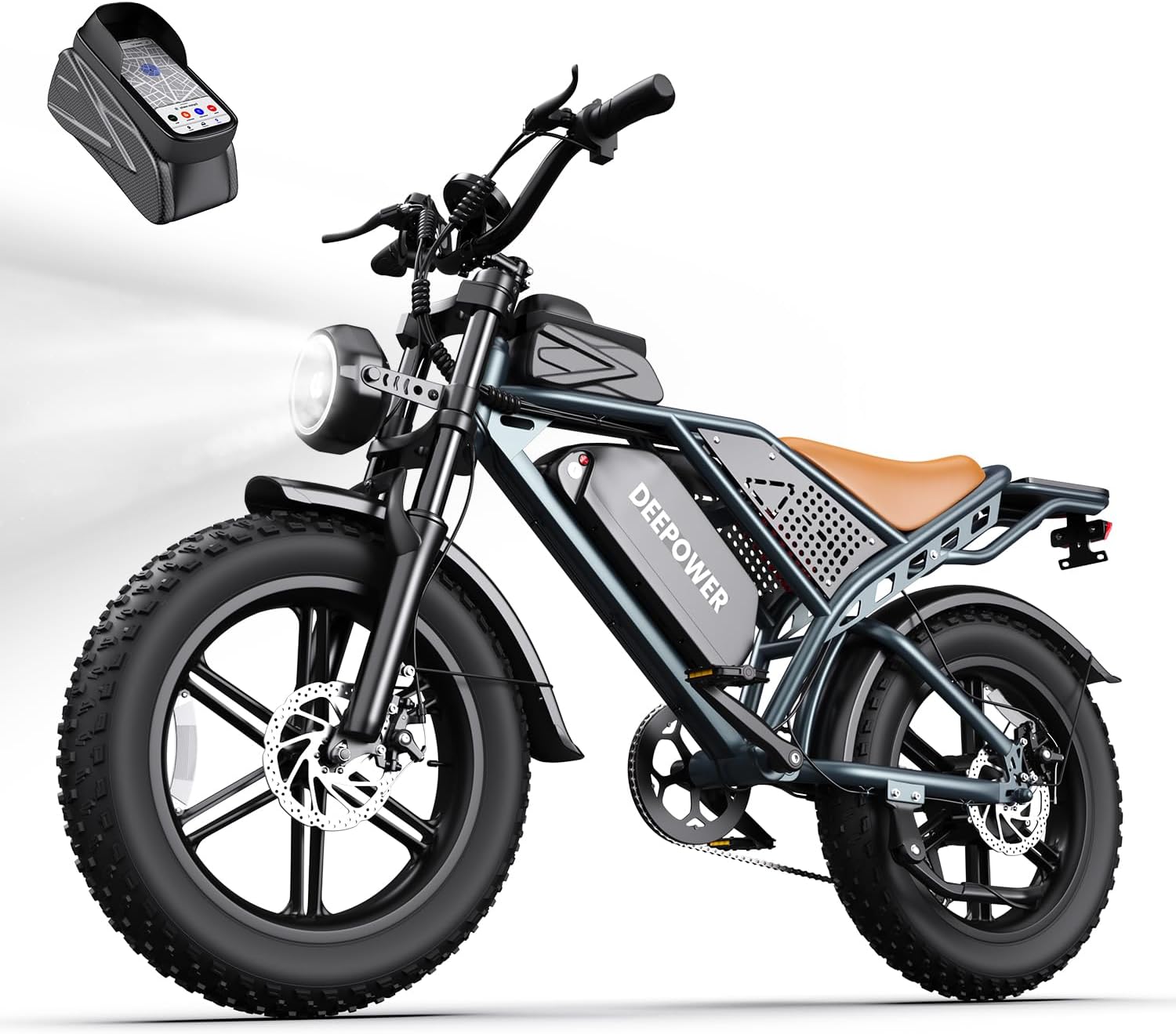
2000W Peak Moped E-Bike
2000W peak motor, 70-160 mile range claim, moped geometry that stays comfortable at speed
A 90-mile spread in its own range claim, no listed voltage or battery cell brand, and no UL certification stated
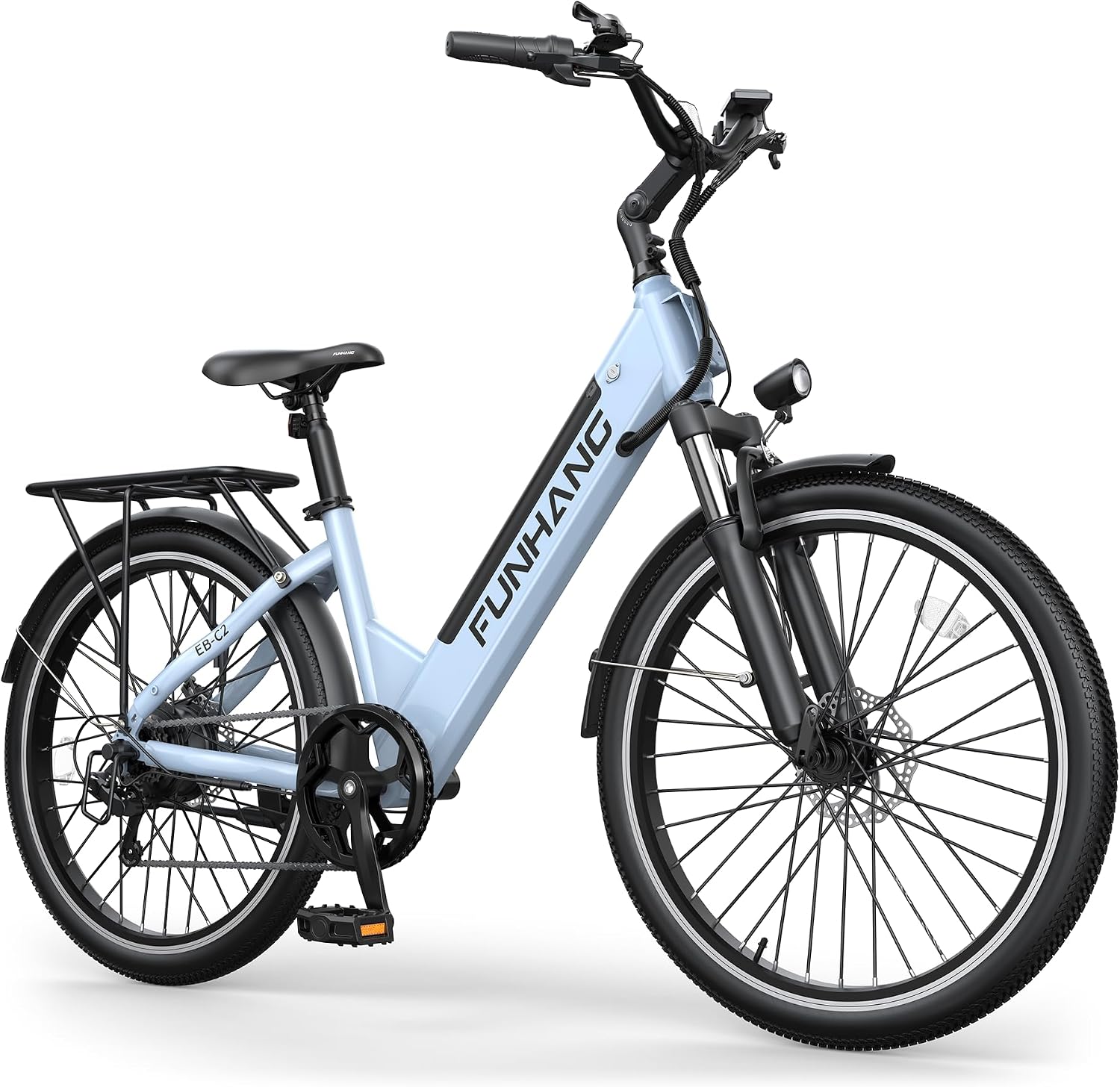
Funhang 1000W Peak Step-Thru Commuter
UL 2849 certified, 48V built-in removable battery, step-thru frame, adjustable stem, 7-speed, 50-mile range claim
1000W peak is the least power in this group, and 50 miles is the shortest range claim of the four
Prices and availability were captured from Amazon Creators API and may change.
How I judge an e-bike before anything else
My order of operations never changes. Voltage and wattage first, price second. I want to know whether the pack is 48V or 52V, and whether that wattage figure is peak or continuous, because those two numbers describe completely different bikes. A 1000W peak motor and a 6000W peak dual motor setup are not the same category of machine, and no amount of screen size or app features closes that gap.
After that I look at three things sellers like to bury. Brakes, because hydraulic discs are not a luxury at 30 MPH, they're the difference between stopping and hoping. Suspension, because that's where cheap bikes cheat hardest, and a fork that rattles your teeth out on a washboard trail is a fork that will rattle them out on your commute too. And weight capacity, because I'm almost 200 lbs and I'm the test nobody else runs.
Then, and only then, do I look at what the bike costs.
E·Bycco 6000W/9000W dual motor: the bike that makes the others look slow
The E·Bycco is the outlier in this comparison and it isn't close. A 52V 32AH battery, a 6000W motor with a 9000W peak rating, dual motor drive, full suspension, hydraulic brakes, and a 50 MPH top speed claim with a 110-mile range claim on top. It wears 24" and 26" fat tires and it's built for off-road mountain duty.
This is the one I keep for long trail days, and it's the reason I tell people to decide what kind of rider they are before they shop. When I say a 52V system with that much battery has power for days, I mean it pulls no matter what the hill looks like. Full suspension and hydraulic brakes aren't upsells here, they're the price of admission at those speeds.
Here's my problem with it, though, and it's the same problem I have with any dual motor bike. Two motors means two controllers, two wiring harnesses, and two places for something to go wrong in the rain. It's heavier than everything else in this group, and 24"/26" fat tires roll slow and loud on pavement. If your riding is 90% city and 10% trail, you are buying a lot of bike you won't use.
Jasion Thunder 1800W: the fat tire middle that fits most people
If I could only hand someone one link from this list, it would be the Jasion Thunder, and the specs explain why. An 864Wh battery paired with a 1800W peak motor, an 80-mile range claim, 30+ MPH, 26" fat tires, and a 400 lb capacity rating. It's also UL 2849 certified, which is the detail I check before I check anything else on a budget bike.
That 400 lb figure matters more than people think. The bikes that feel sketchy under a heavy rider are the ones with an unstated or optimistic weight rating, and the frame flex shows up on the first real climb. A stated 400 lb capacity is the manufacturer telling you it thought about riders like me.
The trade-off is honest. The listing doesn't claim hydraulic brakes, and it doesn't claim full suspension, so I'd assume cable discs and a front fork and plan accordingly. The 1800W peak figure is healthy for a single motor, but it's still half of a dual motor setup, and a long climb at 200 lbs will tell you the difference. As an all-rounder that commutes on weekdays and handles gravel on weekends, this is the most sensible bike of the four.
The 2000W moped: the biggest range claim and the fewest answers
The 2000W peak moped-style bike has the strangest spec sheet of the group, and not because of the power. The range claim runs from 70 to 160 miles, which is a 90-mile spread. That isn't a spec, it's a range of possibilities, and it tells you the seller measured the low number with the throttle pinned and the high number with a light rider pedaling in the lowest assist mode on flat ground.
What I like: moped geometry is genuinely comfortable at speed, the 2000W peak motor is respectable, and if the high end of that range is even half true, it's the longest-legged commuter here. What I don't like: the listing doesn't state the pack voltage, doesn't name the battery cell manufacturer, and doesn't state a UL certification. Sellers who hide the cells lose me. If you won't say LG, I assume the worst, and I shop like it.
This is the bike I'd ask the most questions about before buying. Ask the seller what the voltage is. Ask who makes the cells. If the answers are vague, you've learned what you needed to know.
Funhang 1000W step-thru: the commuter, and the cheapest way in
The Funhang is the smallest bike in this group by intent, and it's the one I'd hand to someone who wants an e-bike for errands, flat-ish commutes, and getting back into riding. A 48V battery that's built in but removable, a step-thru frame, an adjustable stem, a 7-speed drivetrain, a 50-mile range claim, and UL 2849 certification.
The 1000W peak motor is the least power here, and I want to be straight about what that means. On a Denver hill with me on it, that's a bike that will get you up but won't feel effortless doing it. The adjustable stem and step-thru frame, though, are the kinds of practical touches that make a bike get ridden instead of parked. Low step-over height matters if you're carrying groceries, wearing work clothes, or nursing a hip that complains.
It's also the easiest of the four to live with in an apartment or a garage corner. If you want a bike that feels like a bike and not a small motorcycle, this is the pick.
Peak watts versus what you actually feel
This is where most buyers get taken. Peak wattage is a spike number. It's the maximum the controller will allow for a moment, usually on a launch or a steep grade, and it's the number that ends up in the product title because it's the biggest one available. Continuous power is the number that describes your whole ride, and it's the number sellers leave out.
So when you see 6000W peak next to 2000W peak next to 1800W peak next to 1000W peak, don't read it as a linear ladder. Read it as four sellers describing their ceiling with four different levels of honesty. The E·Bycco also lists its voltage and its amp-hours, which lets you sanity-check the claim. The moped lists neither. That difference tells you more about the two bikes than the wattage does.
Voltage matters just as much. A 52V system and a 48V system with the same amp-hour rating are not the same pack, and the 52V bike will hold its speed better as the battery drains. That's why I cross-shop by voltage before I look at anything else.
Range claims, and who was riding when they measured
Look at the four range numbers again: 110 miles, 80 miles, 70 to 160 miles, 50 miles. They were all measured under different conditions by riders who were almost certainly lighter than me, on flatter ground, in better weather, at assist levels most owners never use.
The only range number I trust is the one I log myself. I track every mile on my long loop and photograph the battery meter at the end of each ride, and the honest answer is that real-world range lands well under the sticker. That doesn't make the claims lies. It makes them best-case marketing. If a bike claims 80 miles, plan your day around 40 and be pleasantly surprised.
The trade-offs, stated plainly
Buy the E·Bycco if you want the fastest, most capable, longest-range bike here and you're willing to carry the weight, maintain two motors, and accept that it's a trail bike first. Buy the Jasion Thunder if you want one bike for everything, and the UL 2849 certification and 400 lb rating give you a reason to trust it. Buy the 2000W moped if maximum range is your priority and you're comfortable asking a seller hard questions about voltage and cells. Buy the Funhang if you want a light-duty, certified, genuinely easy bike to live with and you don't care about winning a drag race.
What none of these are is a substitute for checking the bike yourself when the box shows up. Assemble it properly, torque everything, bed the brakes in, and ride it before you decide it's the right size. Shipping scuffs happen and I shrug them off. A loose stem doesn't get shrugged off.
What I'm watching next
I'm still running a long-term range test on my 52V E·Bycco, logging a 10-mile trail loop daily and photographing the meter at the end of every ride, mainly to see whether the pack holds its capacity through a full season. I'm also watching whether that moped listing ever publishes its voltage and cell manufacturer, because that single detail would move it up my list fast. When a seller answers the hard questions, I notice. When they don't, I write it down.