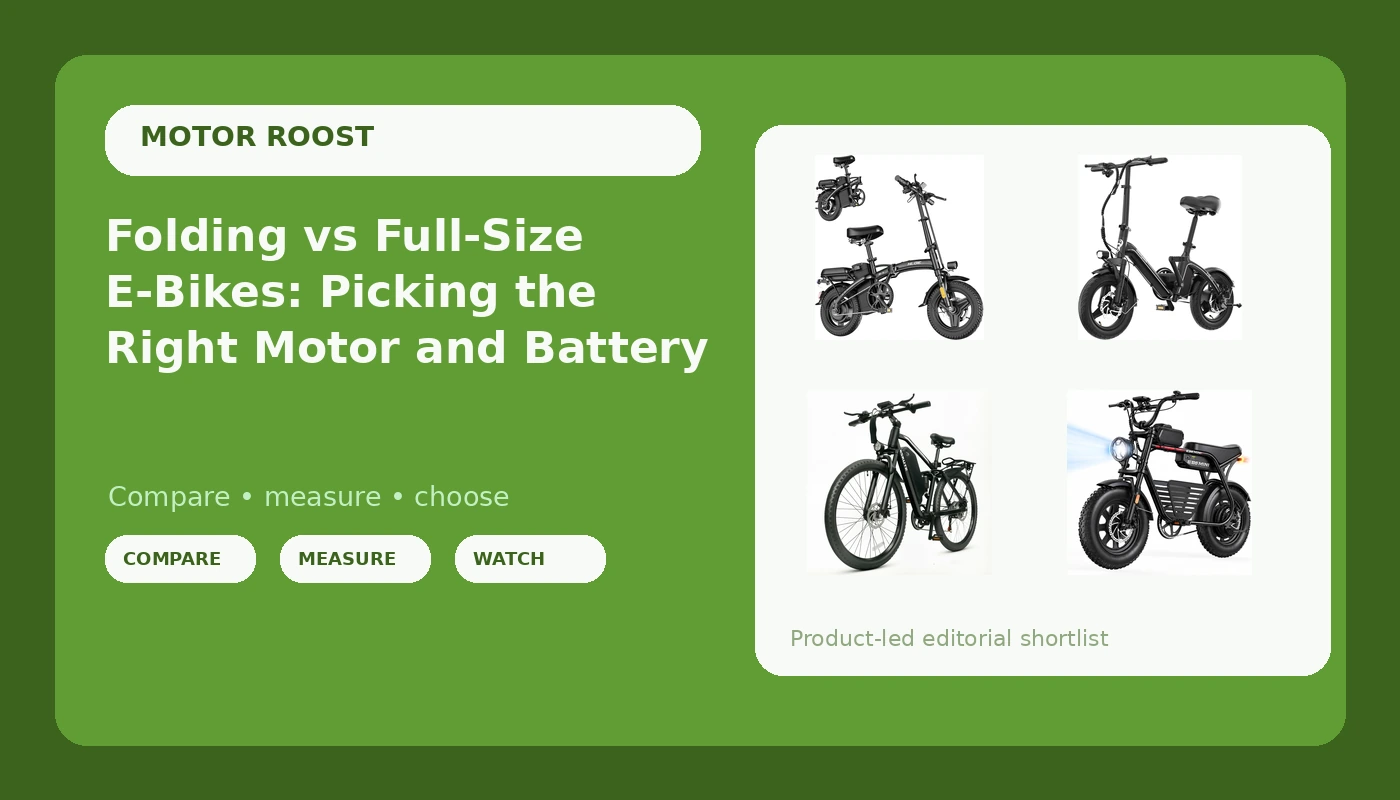
Most people start shopping for a folding electric bike or a full-size commuter by looking at the price, and that is the wrong end of the decision. The bike has to fit where you live, cover the distance you actually ride, and move your weight up the hills on your route. Those three things decide voltage, amp-hours, wheel size, and frame type long before price enters the conversation. Below are four listings that sit in different corners of that map: two folding bikes on 14-inch wheels, one full-size mountain frame with the biggest battery of the group, and one full-size option built around a 1500W peak motor. The goal is not to rank them. The goal is to show you which spec matters for the ride you have.
Related: How E-Bike Battery Voltage and Amp-Hours Actually Work →
Quick answer
Pick the frame that fits your storage and the battery that fits your round trip, then check the motor against your weight and your hills. A 14-inch folding bike with a 48V 12Ah pack covers short urban trips and lives in a closet. A full-size 27.5-inch bike with a 48V 20.8Ah pack is built for longer rides and rougher surfaces. A 36V 10Ah folding bike is the shortest-range option in this group, and a 48V 13Ah bike with a 1500W peak motor trades battery capacity for motor power at a lower cost.
Four useful options
| Model | Best fit | What stands out |
|---|---|---|
| ESKUTE M200F Electric Bike for Adults, 27.5 inch Tire Mountain E-Bike, 1500W Peak Brushless Motor 31+MPH, 48V 20.8Ah Removable Battery, Up to 80 Miles, Step Over Commuter E-MTB, Full Suspensions | Long rides and mixed surfaces | 48V 20.8Ah removable pack, 1500W peak motor, 27.5-inch tires, full suspension |
| Electric Bike for Adults with 48V 13Ah Removable Battery, 1500W Peak Motor | Motor power on a tighter budget | 1500W peak motor with a 48V 13Ah removable battery |
| HLOIE Folding Electric Bike for Adults, 750W Peak Motor, Up to 20 MPH, 14” Foldable Ebike with 48V 12Ah Battery, 35 Miles PAS Range, Mini Electric Bicycle for Adults & Teens | Folding bike with the larger pack | 48V 12Ah battery, 750W peak motor, 14-inch folding frame |
| Bodywel Folding Electric Bike for Adults Teens, 400W Peak Motor Electric Bicycle, 20MPH Max Speed & 25 Miles Long Range, 36V 10Ah Battery, 14" Mini E-Bike | Lowest-cost folding option | 36V 10Ah battery, 400W peak motor, 14-inch mini frame |
The long-range pick: ESKUTE M200F
The trade-off here is weight and footprint. A step-over frame with 27.5-inch tires and a 20.8Ah pack is not going up a flight of stairs or into a car trunk without a fight, and it is not the bike you fold into a closet. What it buys you is the only battery in this group that is realistically sized for long rides, plus the wheel diameter and suspension travel to handle surfaces a 14-inch folder was never designed for. The 80-mile figure is a listing claim tied to a specific assist scenario, so treat it as an upper bound rather than an average.
The power-per-dollar pick: 48V 13Ah, 1500W peak
This is the clearest example of why you read two specs, not one. The peak wattage matches the pricier bike, but the pack is 13Ah against 20.8Ah, so the realistic range is shorter by a wide margin. If your commute is short and your route has a real climb in it, that trade can make sense. If your ride is long and flat, you are paying for motor headroom you will rarely use while giving up the capacity you actually need. Also note what the listing does not say: there is no wheel size, no frame geometry, and no brake spec in the title, so open the full listing before you commit.
The folding commuter pick: HLOIE 14-inch folder
Between the two folders, this one carries the higher voltage and the larger pack, and that is the difference you feel on a longer errand. The 35-mile figure is a pedal-assist claim, which means it assumes you are turning the cranks, not riding on throttle alone. Small wheels steer quickly and pack down small, but they read road surface more directly than a 27.5-inch tire, so pick your routes with that in mind. The frame hinge is the part to inspect first when the box arrives.
The budget folding pick: Bodywel 14-inch folder
Lower voltage and fewer amp-hours both point the same direction: less capacity and less assist. For flat, short hops to the store, the bar, or a train platform, that is often all you need, and it is the least expensive way into a folding e-bike here. For a hilly commute or a rider anywhere near 200 pounds, the 400W peak motor and the 360 watt-hours will run out of room before the other three bikes do. Buy it for the trip it was built for, not for the trip you are hoping it can stretch to.
Prices and availability may change. Product images, names, and retailer links are matched to verified listings. No current price, rating, stock status, or measured result is stated here without current evidence.
What voltage and amp-hours actually buy you
Two numbers on every listing do most of the work: volts and amp-hours. Multiply them and you get watt-hours, which is the closest thing to a real capacity figure you can calculate from a spec sheet. The ESKUTE M200F runs a 48V 20.8Ah pack, which works out to roughly 998 watt-hours. The 48V 13Ah listing sits at about 624. The HLOIE folder is around 576. The Bodywel folder, at 36V 10Ah, is about 360.
None of those numbers converts directly into miles, because range depends on assist level, rider weight, terrain, temperature, and how much you pedal. A bike ridden in the lowest pedal-assist setting on flat ground goes much further than the same bike ridden on throttle into a headwind. That is why a listed range is a scenario, not a promise.
Voltage also shapes how the system behaves. A 48V system generally delivers more torque and a higher top speed than a 36V system of similar capacity, which is why the 36V folder here is the shortest-range option. Peak watts describe how much power the controller can push briefly, usually on a climb or from a standstill, and a 1500W peak rating is not the same thing as 1500W continuous. Listings rarely separate the two, so assume peak means peak.
Folding frame or full-size frame?
Wheel size is the dividing line. The HLOIE and the Bodywel both roll on 14-inch wheels and fold at the middle of the frame. The ESKUTE M200F rolls on 27.5-inch tires on a step-over frame.
Small wheels make a bike compact when folded and quick to steer, but they read potholes, curbs, and gravel differently than a 27.5-inch tire. On smooth pavement that difference is minor. On broken city asphalt it is not, and it grows with rider weight and speed. A folding frame also puts a hinge in the middle of the main tube, which is a wear point: check latch engagement when the bike arrives and keep the mechanism clean.
Full-size frames ride more predictably at speed and carry weight more calmly, but they do not fold. The suspension spec matters just as much. The ESKUTE lists full suspension front and rear. Folding bikes at this level generally do not, and a stiff fork passes hits straight through to your wrists on the same surface a good one absorbs.
A five-step way to narrow the list
- Measure where the bike will live. A closet, a trunk, or an elevator decides the frame type before anything else does.
- Work out your realistic round trip in miles, then add margin for wind, cold, and detours.
- Multiply volts by amp-hours on each listing to compare capacity on equal footing.
- Check peak watts against your weight and the steepest hill on your actual route.
- Read what the listing leaves out, including wheel size, frame type, and brake spec, and open the full page before ordering.
Practical notes before you order
- Budget real assembly time. Folding bikes and full-size bikes both arrive mostly assembled but need the handlebars, pedals, and front wheel checked and torqued.
- Inspect the box before you sign for it, and photograph any shipping damage while the packaging is still there.
- On a folding bike, confirm the hinge latch is fully engaged before every ride. It is the one part that fails loudly if it fails at all.
- Keep 14-inch tires near their rated pressure. Small wheels lose air faster and feel vague when they are soft.
- Check your state and local rules on where a bike with a throttle or a 20 mph plus top speed is allowed, and read the warranty before you change any controller or display setting.
Which option should you choose?
Choose the ESKUTE M200F when your rides are long, your surfaces are mixed, and the bike has a garage or a ground-floor spot to live in. Choose the Electric Bike for Adults with 48V 13Ah Removable Battery, 1500W Peak Motor when your route includes a serious climb but stays short enough that 13Ah covers it. Choose the HLOIE Folding Electric Bike when the bike has to fold, you want the larger 48V pack of the two folders, and your trips are short to moderate. Choose the Bodywel Folding Electric Bike when the job is flat, short, and occasional, and the folding format matters more than range or motor output.
The caveat is the same for all four. None of these listings publishes independent third-party range testing, and range claims shift with assist mode, rider weight, terrain, and temperature. Verify the current spec sheet on the listing itself before you buy, because titles get edited and specs get revised.
The bottom line
Voltage and amp-hours decide how far you can go. Peak watts and wheel size decide how the bike feels while you get there. Frame type decides whether the bike fits your life at all. Work through those in order and the choice between a 14-inch folder, a 27.5-inch trail bike, and a budget 1500W build stops being a guess. Match the bike to the ride you take every week, not the ride you imagine taking once.