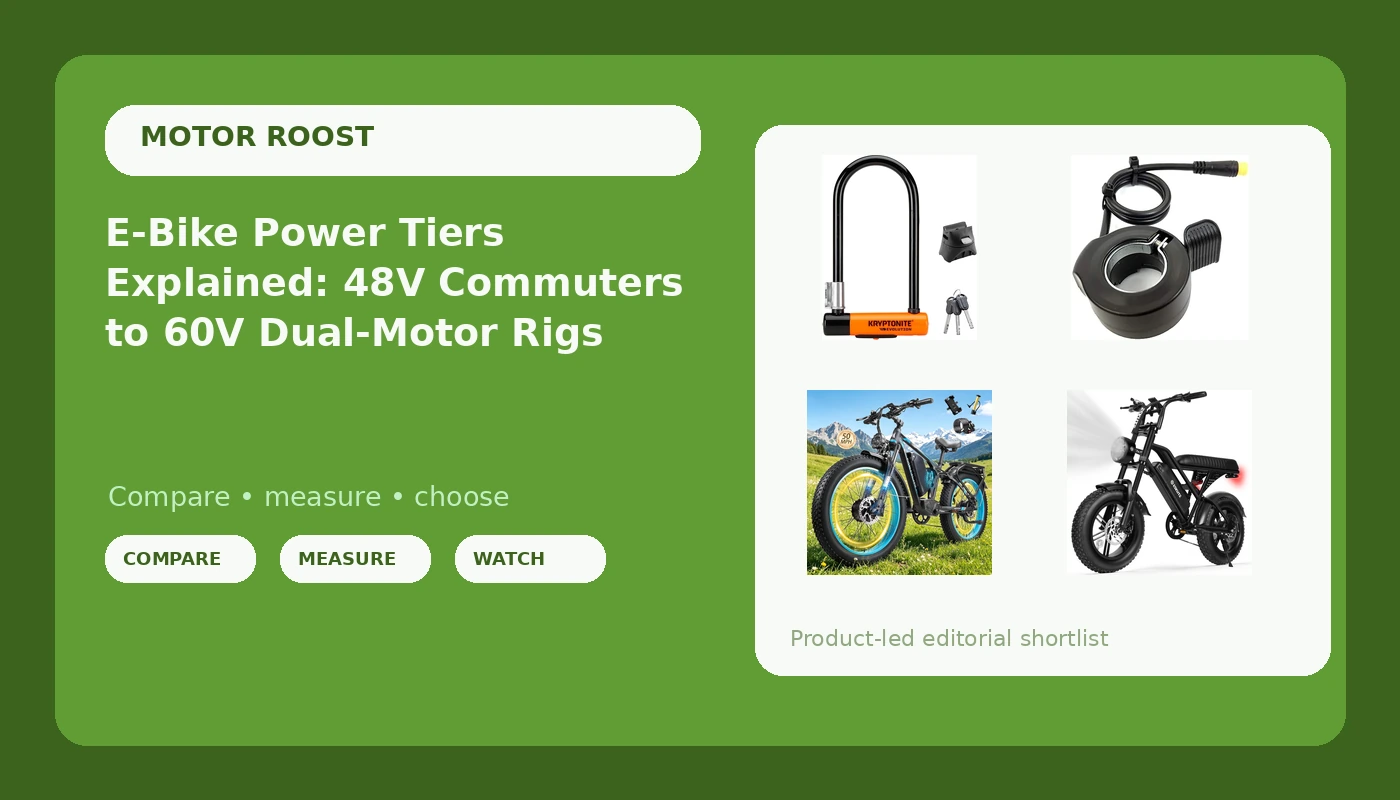
Electric bike power tiers are the fastest way to sort a market that lists a 48V commuter and a 60V dual-motor machine as if they were the same purchase. Voltage sets the class of the system, motor wattage sets how hard it can pull, and amp-hours set how long it can keep pulling before you start watching the meter. Once those three numbers make sense, the rest of the spec sheet stops being noise, and the accessories that keep the bike yours stop looking like afterthoughts. This is the short version: what separates the tiers, and which of four options fits the riding you actually do.
Related: How to Read an E-Bike Spec Sheet Without Getting Fooled →
Quick answer
Sort by voltage and motor rating first, then by battery capacity, then by the parts that keep the bike in your garage. In this group, the MENORX dual-motor model is the only 60V system and carries the highest motor rating, the ESKUTE V100 is the lighter 48V all-terrain option, and the Kryptonite U-lock and Schuck thumb throttle are the two support parts that decide whether the bike stays yours and whether you can control it the way you want. Buy the tier that matches your terrain and your weight, not the tier that photographs best.
Four useful options
| Model | Best fit | What stands out |
|---|---|---|
| MENORX 8000W Dual Motor Electric Bike for Adults | Riders who want maximum power and range in one package | 60V 25Ah lithium battery, dual motor with an 8000W rating, 26-inch fat tires, full suspension, claimed 50MPH and 120-mile range |
| ESKUTE V100 Electric Bike for Adults | Commuters and trail riders who want a lighter, lower-voltage all-terrain bike | 48V 13Ah battery, 1500W peak motor, 16-inch fat tire, dual suspension, 7-speed gearing, claimed 20+MPH and 60-mile range |
| Kryptonite Evolution Standard Bike U-Lock | Anyone parking a bike in public | 14mm steel shackle and three keys |
| Schuck E-Bike Thumb Throttle 130X | Builders replacing or adding a throttle | Waterproof accelerator, fits 22.2mm (0.87in) handlebars, left or right mounting |
The 60V tier: MENORX 8000W Dual Motor Electric Bike for Adults
A 60V system is not a 48V system with a bigger sticker. Higher voltage means the motor can be fed more power for the same current draw, which is why 60V builds tend to feel stronger on climbs and hold speed better once you are already moving. Adding a second motor spreads that work across two wheels, which helps most in loose dirt, sand, and snow where a single rear wheel spins and digs. The 25Ah pack is the other half of the story: 60V multiplied by 25Ah works out to roughly 1,500 watt-hours, a big reserve compared with the commuter-class packs on most 48V bikes.
The trade-offs are real. Dual motors and a pack that size add weight, and weight is what you feel when you are pushing the bike up a flight of stairs or lifting it onto a rack. Higher-voltage machines also attract more attention from the rules side of the equation, so check what your state and the trails you ride allow before you assume a bike like this is street legal everywhere. A bike that gaps everything on the trail is worth nothing if it is impounded.
The 48V tier: ESKUTE V100 Electric Bike for Adults
This is the tier most riders should start in, and it is the tier that keeps earning its place after the novelty wears off. A 48V 13Ah pack works out to roughly 624 watt-hours, which is enough for a real commute or a trail loop if you are honest about how much throttle you use. The 7-speed drivetrain matters more than people expect: on a bike this size, being able to shift into a lower gear is what gets you home when the battery is low and the last hill is steep. Dual suspension on a 16-inch fat tire is the combination that keeps a short-wheelbase bike from rattling your teeth out on washboard dirt.
The honest limitation is headroom. A 1500W peak motor and a 624 watt-hour pack will not hold highway-adjacent speeds for an hour, and a heavy rider on a long climb will feel the difference between this and a 60V machine. What you get instead is a bike that is easier to store, easier to lift, cheaper to feed, and more likely to be legal on the paths you actually ride. Range and top-speed figures are manufacturer claims, and they move a lot with rider weight, terrain, and how much you lean on the throttle.
The security piece: Kryptonite Evolution Standard Bike U-Lock
Nobody cross-shops a lock by voltage, which is exactly why it gets skipped. An e-bike is a much bigger target than a pedal bike: the battery alone is worth carrying away, and a bike that costs four figures is the kind of thing that gets cased, not stolen on impulse. A U-lock with a 14mm shackle is the shape of lock that resists the tools someone actually carries, and a standard-format U-lock gives you more places to thread it than a folding lock or a chain.
Two practical notes. First, three keys means you can leave one at home, one at work, and still carry one, which is the difference between locking up every time and locking up when it is convenient. Second, a U-lock only protects what it goes through, so run it through the frame and a wheel, and take the battery with you when the bike is going to sit somewhere unattended for hours.
The control piece: Schuck E-Bike Thumb Throttle 130X
Throttles die. They get rained on, they get dropped, the hall sensor gives up, and suddenly a perfectly good bike is a very heavy pushbike. A replacement thumb throttle is a small part that decides whether a build stays on the road, and it is the kind of thing worth keeping in a drawer before you need it. The 22.2mm bar diameter is the standard clamp size on the vast majority of flat and riser bars, and left-or-right mounting means it works whether you want the throttle opposite the shifter or opposite the display.
The waterproof housing is the detail that matters if you ride in weather. The one thing to verify before ordering is the connector on your existing throttle, because plug shape and pin count vary between controllers and that is the part a listing photo will not tell you. Match the connector and the bar diameter, and this is a ten-minute job.
Prices and availability may change. Product images, names, and retailer links must be matched by verified ASIN. Do not state a current price, rating, stock status, or measured result without current evidence.
How voltage, wattage, and amp-hours relate
Three numbers do most of the work. Voltage is the pressure of the system, amp-hours is the size of the tank, and wattage is how fast the motor can drain it. Multiply voltage by amp-hours and you get watt-hours, which is the closest thing to a real range number you can calculate yourself. A 48V 13Ah pack comes out to roughly 624 watt-hours. A 60V 25Ah pack comes out to roughly 1,500. That is more than double the stored energy, which is why the two bikes in this group do not belong in the same conversation about distance.
Motor ratings need one more layer of care. Peak wattage is what a motor can pull briefly under load, and continuous wattage is what it can hold without cooking itself. A bike advertised at 1500W peak is not a 1500W motor in the way a hub motor's nominal rating is stated, and a dual-motor system rated at 8000W is describing the sum of both motors at their peak. None of that is dishonest, but it does mean a peak figure and a nominal figure should never be compared side by side.
There is also a legal layer that specs do not cover. Many states cap street-legal e-bike power and speed, and a 60V machine with a claimed 50MPH top speed is not going to fit inside a class 1, 2, or 3 definition in most places. That does not make it a bad bike. It makes it a bike you should understand before you buy it, and one worth confirming against your local rules and the rules of any trail system you plan to ride.
How to choose a tier without wasting money
- Decide the terrain first. Pavement and groomed paths do not need a second motor; loose dirt, sand, and steep grades are where dual motors earn their weight.
- Write down your real round-trip distance, then add 30 percent. Range claims assume a lighter rider, flat ground, and ideal weather, so plan for the number to shrink.
- Check the voltage class against your local law. A 60V bike and a 48V bike are not interchangeable at the trailhead or in front of a police officer.
- Budget for the parts nobody photographs. A lock, a spare throttle, and a set of tools cost a fraction of the bike and decide how long you keep it.
- Confirm the mechanical details before ordering. Bar diameter, throttle connector, axle spacing, and wheel size are the four things that turn a simple install into a return.
Practical guidance
- Weigh the bike you are considering, not just the price. A heavier machine is harder to lift onto a rack, up stairs, and into a garage, and that friction adds up daily.
- Buy the lock with the bike, not after. The first week is when a new e-bike is most likely to be noticed and least likely to be secured properly.
- Keep a spare throttle and a spare tube on hand. The parts that strand you are almost always the small ones.
- Treat every range and top-speed figure as a manufacturer claim. Real numbers move with rider weight, hills, wind, tire pressure, and how much throttle you use.
- Learn how your controller and display handle assist levels before you start changing settings. Understanding what mode 3 actually does is more useful than chasing a higher number.
Which option should you choose?
Choose the MENORX 8000W Dual Motor Electric Bike for Adults when you want the highest-output system in this group and your riding includes loose terrain, long distances, or both. Choose the ESKUTE V100 Electric Bike for Adults when you want a lighter, lower-voltage all-terrain bike for commuting and mixed-surface loops, with gearing you can pedal home on. Choose the Kryptonite Evolution Standard Bike U-Lock when the bike is going to be parked anywhere other than inside your own garage. Choose the Schuck E-Bike Thumb Throttle 130X when you are replacing a dead throttle or converting a build and need a part that fits 22.2mm bars on either side.
The caveat that applies to all four: the bikes are described by their manufacturer specifications, and the range and speed figures quoted above are claims, not verified results. Rider weight, terrain, temperature, and assist level all move those numbers, sometimes by a lot. Check the specs against your own riding and your own local rules before you commit.
The bottom line
Voltage and motor rating set the tier, battery capacity sets how far that tier can take you, and the small parts decide how long you keep it. If maximum power and range are the priority and your terrain justifies it, the 60V dual-motor MENORX is the top of this group on paper. If you want a lighter, easier-to-live-with all-terrain bike, the 48V ESKUTE V100 is the more sensible tier for daily riding. Whichever you pick, add a U-lock and a spare throttle on day one, because the bike you still own in three years is the one you actually planned for.