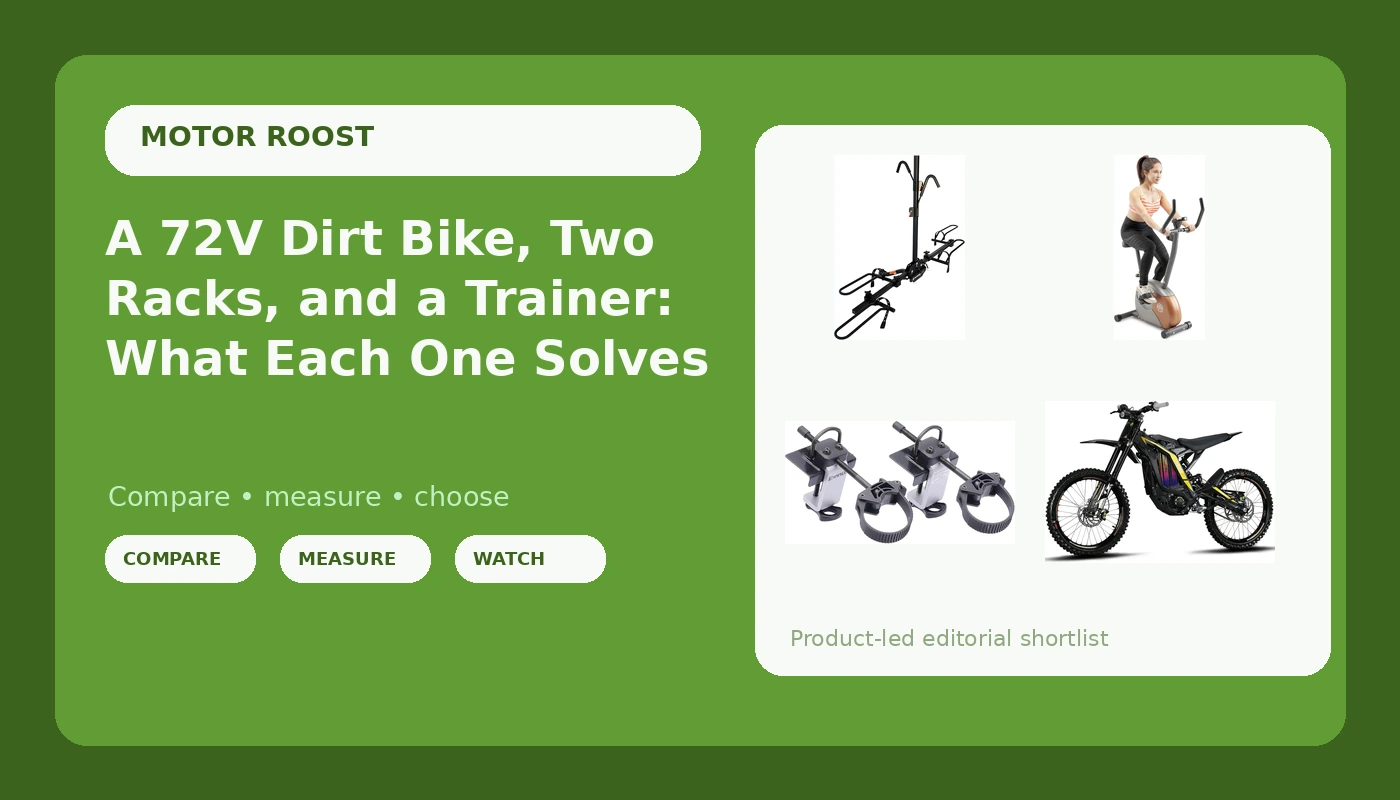
Most people shopping for a motor and two wheels think the purchase ends at the bike. It does not. A 72-volt off-road machine has to get to the trail, has to be tied down so it does not become a projectile on the highway, and has to have something useful to do during the months when the high country is buried.
That is why this guide covers four products that solve four different problems: an off-road electric dirt bike, a hitch-mounted platform rack, a truck bed mount, and an indoor exercise bike. If you find yourself cross-shopping an electric dirt bike and bike racks in the same week, you are not confused. You are doing it in the right order.
The questions that actually matter are boring and physical. How much does the machine weigh, and can one person lift an end of it onto a tray? Does your vehicle have a receiver hitch, a bed, or neither? Do you want to ride indoors, or do you just want your legs to stop complaining in January? Answer those three and the list below sorts itself.
Related: How to Pick an E-Bike That Still Works at 200 Pounds →
Quick answer
Match the product to the job, not to a spec sheet. The natkie is the only motorized bike in this group, with a mid-mounted motor rated to 8000W peak, a 72V 30Ah removable battery, and manufacturer claims of 50 mph and up to 76 miles. The Swagman XTC2 carries two bikes on a hitch receiver. The INNO RT201 holds a bike in a standard pickup bed. The Marcy exercise bike is for indoor cardio on adjustable magnetic resistance. None of these four replaces another one.
Four useful options
| Model | Best fit | What stands out |
|---|---|---|
| natkie Electric Motorcycle Bike for Adults | Off-road riding | 72V 30Ah removable battery and an 8000W peak mid-mounted motor |
| Swagman XTC2 Hitch Mount Bike Rack | Vehicles with a receiver hitch | Platform carrier for two bikes with ratcheting hooks and clamshell folding |
| Marcy Home Fitness Personal Exercise Bike | Indoor cardio | Adjustable magnetic resistance for cycle training |
| INNO RT201 Truck Bed Bike Rack | Standard pickup trucks | Bed-mounted bike mount that needs no hitch |
The motorized option: natkie Electric Motorcycle Bike for Adults
Here is the trade-off nobody mentions in the listing photos. A bike in this class is heavy, and heavy bikes are the reason the other three products in this guide exist. A mid-mounted motor puts the mass low and central, which helps handling on the trail, but it does not help you when you are alone in a parking lot trying to get the front wheel into a tray. If this is the bike you want, budget for a carrier rated well above the bike's own weight and plan on a two-person lift the first few times.
The removable 72V pack is the feature worth paying attention to. Being able to carry the battery inside to charge it changes where you can store the bike, and it changes how you handle winter. Voltage also sets the ceiling here: 72 volts gives the motor more headroom for torque than a 52V or 60V system, which is what you feel on a steep, loose climb rather than on flat pavement.
The two-bike carrier: Swagman XTC2 Hitch Mount Bike Rack
Platform racks and hanging racks are not the same purchase. A hanging rack suspends bikes by the frame, which is fine for light bicycles and awkward for anything with a battery, a motor, or a step-through frame. A platform carrier supports each bike by its wheels, which is the design you want once a bike gets heavy, because the load stays low and the frame is not taking the whole weight through two contact points.
The ratcheting hooks are the part to think about before you buy. They clamp down over the frame or the front wheel area, so if your paint matters to you, keep a cloth or a pad where the hook lands. The clamshell fold is the other practical detail: a rack that folds flat can stay on the vehicle between rides instead of living on your garage floor.
Fit matters more than anything else here. Hitch racks depend on receiver size and class, and the combined weight of two bikes plus the rack itself has to stay inside what your vehicle and hitch are rated to carry.
The indoor option: Marcy Home Fitness Personal Exercise Bike
Magnetic resistance is the quiet, low-maintenance approach to a stationary bike. There is no friction pad dragging on a flywheel, so there is nothing to wear out and nothing to readjust every few weeks. Resistance changes by moving magnets closer to or further from the rotating assembly, which gives you a smooth range from easy spin to hard effort.
What an indoor bike does not do is replicate a trail. There is no terrain, no line choice, and no suspension working underneath you. What it does do is keep your legs and your lungs in condition through a Colorado winter so that the first spring ride is not a punishment. If your goal is base fitness rather than dirt-bike skills, this is the cheapest way into the category of the four products here.
The pickup-bed mount: INNO RT201 Truck Bed Bike Rack
A bed mount is the answer for the truck owner who never wanted a receiver rack in the first place. Nothing hangs off the back of the vehicle, the departure angle stays untouched, and the bike rides inside the footprint of the truck. The trade-off is access: whatever the mount occupies is no longer open bed space, and a tonneau cover or a bed rack may or may not coexist with it depending on how the bed is configured.
Before ordering, measure the bed. Length, width, and the height of the bed walls all matter, and so does whether your truck has a bed liner or a track system that changes how a clamp or bracket seats. Bed dimensions vary enough between standard pickup models that this is worth ten minutes with a tape measure.
Prices and availability may change. Product images, names, and retailer links are matched to verified listings. No current price, rating, stock status, or measured result is stated here without current evidence.
What voltage and motor placement actually change
Voltage is the number that sets the ceiling on a system. A 72V pack pushes more electrical pressure than a 52V or 60V pack, so the motor can make the same power with less current, and it has more room to deliver torque when the trail tilts up or the rider is heavier than average. That is why riders who care about climbing tend to sort their shortlist by voltage before they look at anything else.
Peak watts and continuous watts are two different numbers, and listings rarely make the difference obvious. A motor rated at 8000W peak is describing a short burst, not what it will hold for an hour. That is normal for the category and not a red flag, but it does mean you should read a peak rating as headroom rather than as a constant output figure.
Mid-mounted versus hub-mounted is the other split. A mid-drive sends power through the drivetrain, which keeps mass centered and lets the motor take advantage of gearing. Hub motors are simpler and cheaper. For off-road use, the centered mass is the argument that matters, because a bike that carries its weight low and in the middle is easier to control when traction disappears.
Range claims deserve the same skepticism. Manufacturer range figures are generated under specific conditions that include rider weight, terrain, assist level, and temperature, and none of those conditions are yours. A 76-mile claim is a ceiling, not an expectation, and the honest way to use it is as a comparison point between two bikes tested the same way.
How racks and mounts differ
There are three common ways to carry a bike on a vehicle, and they fail in different ways. Hanging racks suspend bikes by the frame from arms. Platform racks support bikes by the wheels in trays. Bed mounts hold a bike upright inside a pickup bed. Platform and bed mounts handle heavy bikes and awkward frames better, because the wheels carry the load and the frame is not pinched.
Tongue weight and receiver class are the numbers that govern hitch racks. The rack itself weighs something, each bike weighs something, and the total has to sit inside both the rack's stated capacity and your vehicle's rated tongue weight. A rack rated for two bikes does not automatically mean it is rated for two of your bikes.
Folding is a usability feature, not a marketing one. A rack that folds up compactly can stay mounted while you park and drive without it, and a mount that stays in the bed has to leave room for the rest of your cargo. Think about the eighty percent of the time you are not carrying a bike, because that is when these products earn their keep or become a nuisance.
- Weigh your heaviest bike, or find its shipping weight, before you shop for any carrier.
- Check what your vehicle actually has: receiver size and class, or bed length, width, and wall height.
- Decide whether the bike needs to travel at all, or whether the riding is happening indoors this season.
- Match the carrier type to the load: platform trays and bed mounts for heavy machines, hanging racks for light ones.
- Budget for the extras that make the setup work, including straps, frame padding, and a torque wrench for assembly.
Practical guidance before you order
- Measure the receiver and confirm the rack's stated capacity covers your heaviest bike plus the rack's own weight.
- Plan assembly before the box arrives, because a heavy machine needs floor space, a stand, and a second set of hands for the final lift.
- Charge and store a removable pack indoors where temperatures stay moderate, and never leave it at zero percent for months.
- Pad the contact points where hooks, clamps, or trays touch paint, and check the pads each season.
- Keep an indoor trainer in the rotation during the off-season so the first ride back is not a shock to your legs.
Which option should you choose?
Choose the natkie Electric Motorcycle Bike for Adults when you want the motorized off-road machine itself and the rest of this list is support equipment. Choose the Swagman XTC2 Hitch Mount Bike Rack when you have a receiver hitch and need to move two bikes on wheel trays. Choose the INNO RT201 Truck Bed Bike Rack when you drive a standard pickup and would rather load into the bed than hang anything off the back. Choose the Marcy Home Fitness Personal Exercise Bike when the riding you need this season happens indoors.
Every specification in this article comes from the manufacturer's product listing. Top speed, range, and power figures are manufacturer claims and vary with rider weight, terrain, assist level, temperature, and battery state. Nothing here is a measured result, and no current price, rating, or stock status is stated.
The bottom line
These four products do not compete with each other, and that is the point. One is a 72-volt off-road machine with a removable 30Ah pack and a mid-mounted motor rated to 8000W peak. Two of them are ways to carry a bike on a vehicle, one by hitch and one by truck bed. One is a stationary bike for the months when going outside is not an option. Figure out which problem is actually blocking you, buy for that, and let the rest of the list wait until it becomes a real problem rather than an imagined one.